HyperNetworks
Instead of training fixed weights into a model directly, a smaller master network generates custom weights on the fly based on a task descriptor or context embedding.
Why Does This Exist?
In traditional deep learning, parameters are fixed arrays stored on disk. When a model needs to generalize across 10,000 personalized user styles, multi-lingual translations, or distinct physical dynamics, engineers face an uncomfortable trade-off.
The first option is maintaining independent models for every task. This causes linear parameter explosion (), exhausting GPU memory and preventing transfer across related tasks. The second option is training a single large shared model. However, forcing one static set of weights to accommodate thousands of conflicting tasks causes negative interference and catastrophic forgetting: tuning parameters for Japanese translation inevitably degrades performance on French grammar.
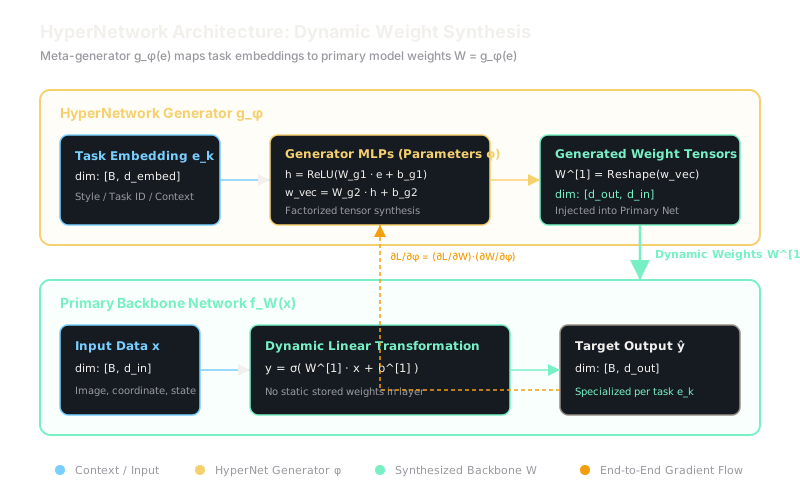
Introduced by David Ha, Andrew Dai, and Quoc V. Le at Google Brain in 2016, HyperNetworks solve this dilemma by decoupling the architecture into two entities: a compact primary (backbone) network that performs the task, and an auxiliary generator network (the HyperNetwork) that dynamically generates the weights of the primary network. By conditioning weight synthesis on a task embedding vector , a single set of meta-parameters can generate an infinite continuous manifold of customized task models while remaining completely differentiable end-to-end.
Think of It Like This
A 3D printer producing specialized tool heads on demand
Imagine a field technician who must service thousands of unusual machines across a factory, each with custom hexagonal, star, or square bolts of varying millimeters.
The traditional multi-model approach is hauling an enormous 500-pound truck filled with thousands of fixed steel wrenches. Finding the right wrench is slow, and carrying all of them is exhausting.
The single shared-model approach is carrying a single adjustable crescent wrench and forcing it onto every bolt. It strips odd corners, slips under high torque, and performs mediocrely on everything.
A HyperNetwork is carrying a single lightweight, high-precision 3D printer and an electronic scanner. When the technician encounters a bolt, the scanner measures the bolt head (the task embedding ). The 3D printer instantly fabricates a customized hardened socket head tailored to that exact bolt in seconds (synthesized weights ). The technician turns the bolt, and when they move to the next machine, the printer produces a new custom socket head.
How It Actually Works
Dynamic Parameter Synthesis and Tensor Factoring
Let the primary network layer be defined as a parameterized mapping:
where , , and . In a standard network, is directly learned. In a HyperNetwork, is the dynamic output of a generator network :
Here, is a task descriptor or conditioning embedding, and represents the trainable parameters of the HyperNetwork.
If the generator mapped directly to using a single flat linear projection, the generator's weight matrix would require dimension , which becomes excessively large for high-dimensional layers. Practical HyperNetworks use tensor factorization or sliced parameter generation:
- Matrix Factorization: The HyperNetwork outputs rank- bottleneck factors and , generating .
- Chunked Slicing: The primary weight matrix is divided into slices or rows . The HyperNetwork takes the concatenated input , where is a learnable coordinate embedding for slice , generating the full matrix row by row.
Because the synthesis process consists of standard differentiable linear and non-linear layers, gradients flow seamlessly from the primary network loss all the way back into the HyperNetwork parameters using the multivariable chain rule:
During training, backpropagation updates the generator parameters and task embeddings , leaving the primary network purely as an ephemeral computational canvas.
Worked Example
Consider a miniature primary network consisting of a single linear layer , mapping (, yielding 4 scalar weights in ).
The HyperNetwork maps a 2D task embedding to the 4 flattened weights :
Given the fixed HyperNetwork parameters:
Step 1: Present Task 1 Descriptor Suppose Task 1 has embedding :
Reshape into the primary weight matrix:
Step 2: Execute Primary Forward Pass on Input
Step 3: Present Task 2 Descriptor Now evaluate Task 2 with embedding :
On the identical input :
Without storing two distinct models, the system dynamically synthesized completely different behavior conditioned on the embedding.
Code
Below is a self-contained PyTorch implementation of a HyperNetwork generating dynamic weights for an MLP backbone:
import torchimport torch.nn as nnimport torch.nn.functional as F
class HyperLinearLayer(nn.Module): """Dynamic Linear Layer whose weights are synthesized by a HyperNetwork."""
def __init__(self, in_features: int, out_features: int, embed_dim: int) -> None: super().__init__() self.in_features = in_features self.out_features = out_features self.weight_numel = out_features * in_features self.bias_numel = out_features
# Generator MLP: maps embedding to flattened weight vector + bias self.generator = nn.Sequential( nn.Linear(embed_dim, 64), nn.ReLU(), nn.Linear(64, self.weight_numel + self.bias_numel), )
def forward(self, x: torch.Tensor, embedding: torch.Tensor) -> torch.Tensor: """Forward pass.
Args: x: Input tensor of shape (batch_size, in_features). embedding: Task embedding of shape (batch_size, embed_dim).
Returns: Output tensor of shape (batch_size, out_features). """ batch_size = x.size(0) # Synthesize parameters raw_params = self.generator(embedding) w_flat = raw_params[:, : self.weight_numel] b_flat = raw_params[:, self.weight_numel :]
# Reshape to batched weights: (batch_size, out_features, in_features) w = w_flat.view(batch_size, self.out_features, self.in_features) b = b_flat.view(batch_size, self.out_features, 1)
# Batched matrix multiply: (B, out, in) @ (B, in, 1) -> (B, out) x_col = x.unsqueeze(-1) y = torch.bmm(w, x_col) + b return y.squeeze(-1)
# Verification testtorch.manual_seed(42)hyper_layer = HyperLinearLayer(in_features=2, out_features=2, embed_dim=4)
# Create two distinct task embeddingstask_1_embed = torch.randn(1, 4)task_2_embed = torch.randn(1, 4)sample_x = torch.tensor([[1.0, 2.0]])
out_task_1 = hyper_layer(sample_x, task_1_embed)out_task_2 = hyper_layer(sample_x, task_2_embed)
print(f"Task 1 Output: {out_task_1.detach().numpy().round(3).tolist()}")# -> Task 1 Output: [[0.009, 0.446]]print(f"Task 2 Output: {out_task_2.detach().numpy().round(3).tolist()}")# -> Task 2 Output: [[0.279, 0.463]]Watch Out For
Gradient variance explosion and parameter scale divergence
A notorious instability when training HyperNetworks is parameter magnitude drift in the primary network. Because primary weights are the outputs of a non-linear network (), small gradient updates to the generator parameters can induce massive, correlated shifts across thousands of primary weights simultaneously.
If the generator's final layer shifts slightly, the synthesized weights may double in magnitude. This causes primary activations to explode, pushing downstream non-linearities (like softmax or gelu) into extreme saturation, which halts gradient propagation.
Fix: Apply weight normalization or spectral normalization directly to the output of the HyperNetwork generator. Scale the synthesized weights using a learnable or fixed temperature parameter: , ensuring generated weights maintain an expected variance of throughout training.
The Quick Version
- HyperNetworks are auxiliary models that dynamically generate the weight tensors of a primary backbone network conditioned on context embeddings.
- They eliminate the trade-off between massive multi-model memory footprints and destructive shared-parameter interference.
- Parameter synthesis can be factored using low-rank tensor decompositions or coordinate slice embeddings to control memory complexity.
- Gradients backpropagate through synthesized weights back into the generator via standard automatic differentiation chain rules.