Instruction Tuning
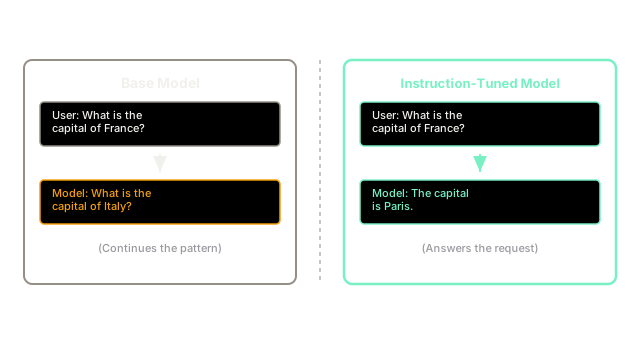
Instruction tuning is the behavioral shift that turns a chaotic autocompleter into a polite assistant. It teaches the model that when a user asks a question, the correct next tokens are the answer, not a continuation of the question.
Why Does This Exist?
If you take a raw, pretrained base model and prompt it with:
"Write a Python script to reverse a string."
The model hasn't been taught to converse. It has been taught to predict the next word on the internet. It might think it is looking at a university exam paper, so it will autocomplete with:
"Write a Python script to sort an array."
"Write a Python script to connect to a database."
It knows how to write Python, but it doesn't know you want it to do it right now. Instruction tuning is the process that bridges this gap. It is a highly specific form of Supervised Fine-Tuning (SFT) designed solely to teach the model a new behavior: Stop autocompleting documents, and start answering requests.
Think of It Like This
The brilliant scholar who doesn't understand interviews
Imagine a scholar who spent forty years locked in a library reading everything ever written, but has never spoken to another human. You bring them out and say: "Explain quantum mechanics." Because they only know how books are written, they assume you are starting a chapter, so they reply: "This chapter will cover the history of quantum mechanics, beginning with Max Planck..."
Instruction tuning is pulling them aside and saying, "When someone says 'Explain X', they are asking you a direct question. Just give them the summary."
How It Actually Works
The Data
Instruction tuning datasets consist of thousands of prompts paired with the exact, desired response.
- Prompt: "Summarize this email: [email]"
- Response: "Here is the summary: [summary]"
Crucially, the responses are written in the persona you want the model to adopt—helpful, harmless, and direct. The dataset covers a wide variety of tasks: brainstorming, coding, translating, summarizing, and declining to answer harmful requests.
The Objective
Instruction tuning uses the exact same mechanism as pretraining: next-token prediction via backpropagation. However, the data is structured into Chat Templates, and the loss on the prompt tokens is masked out (as covered in Fine-Tuning Data Preparation).
The model is forced to predict the tokens of the Response. Because the base model already knows the facts and the grammar from pretraining, it only takes a few thousand examples for the model's weights to shift. It learns the pattern of instruction-following rapidly.
The "Superficial Alignment Hypothesis"
A famous paper (LIMA) proposed that a model's knowledge and capabilities are entirely learned during pretraining. Instruction tuning does not teach the model new facts or how to code; it only teaches the model the format of interacting with users. This is why you can often achieve excellent instruction tuning with just 1,000 highly curated, perfect examples, rather than millions of mediocre ones. Quality matters exponentially more than quantity here.
Watch Out For
Mode Collapse / Sycophancy
If your instruction tuning dataset is too narrow (e.g., the assistant always agrees with the user, even when the user is wrong), the model will become a sycophant. It will prioritize sounding agreeable over being factual, because that is the behavior the SFT data rewarded.
The Quick Version
- Base models are autocompleters; they predict the next text based on internet patterns.
- Instruction tuning is a form of Supervised Fine-Tuning (SFT) that teaches the model to act as an assistant.
- It relies on high-quality pairs of user prompts and perfect assistant responses.
- It does not teach new facts; it only surfaces the capabilities learned during pretraining by aligning them to a conversational interface.