Lp Spaces
Families of functions with finite p-th power integrals, the home of norms, errors and convergence that ML optimizes.
Why Does This Exist?
Errors need sizes: mean absolute error, root mean square error, worst-case error. Each is an norm with different spike tolerance. Theory needs the same sizes to state convergence, generalization and stability without redefining distance each time.
spaces collect measurable functions with , normed by . For these are Banach spaces; is Hilbert with an inner product.
This page defines the family and its two workhorse inequalities. Vector norms are in norms and probabilistic moments in expectation, variance and covariance.
The one idea you need first
A norm measures size with triangle inequality: . norms apply this to functions via integrals instead of sums.
Think of It Like This
Fines for speeding
fines every mile-per-hour over the limit equally. fines the square, so a brief -over spike costs far more than long -over cruising. fines only the peak speed.
Error norms choose the fine schedule. Robust losses pick to forgive spikes; least squares picks to punish them. Where the analogy stops: fines are one-sided, while norms treat positive and negative deviations symmetrically.
How It Actually Works
for , and . Holder: with . Minkowski: . Both need .
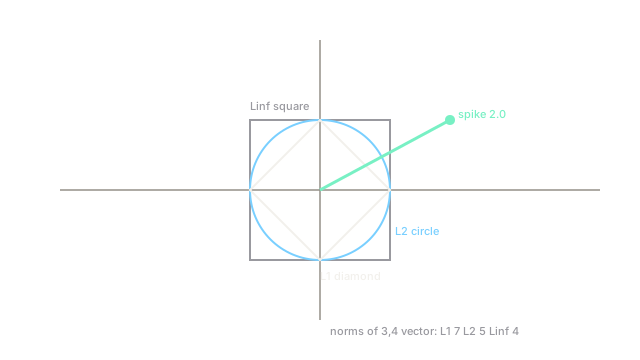
For vectors : norm , norm , norm . The ordering holds in finite dimensions up to constants; on infinite measure spaces inclusions reverse or fail.
Worked example
On , . Then integrates to , so . For , diverges at , so . Same function lives in and but not : higher is stricter about spikes.
Watch Out For
Using triangle inequality below p equals 1
Symptom: assumed, then sparsity penalties violate it and proofs collapse. Fix: for only a quasi-triangle holds with a constant; state it or stay at .
Assuming norm equivalence in infinite dimensions
Symptom: "all norms are equivalent" quoted for function spaces, so convergence is read as convergence. Fix: equivalence holds only in finite dimensions; in function spaces exhibit the mode of convergence explicitly.
The Quick Version
- collects functions with finite ; give MAE, RMSE and worst-case sizes.
- Holder controls products and Minkowski controls sums for .
- Larger punishes spikes harder: is in with norm but outside .
- alone has an inner product; all with are complete.
- Name whenever an error or risk bound is stated.