Markov and Chebyshev Inequalities
Guarantees from almost nothing: the mean alone caps far-out chances, and adding the variance tightens the cap enormously.
Why Does This Exist?
Real variables arrive with unknown shapes. A latency distribution, a returns series, a sensor stream: you know a mean and a variance and nothing else, yet you must promise something about extremes. Service agreements cap tail latency, risk limits cap large losses, and both need guarantees that survive any shape the data might take.
Markov and Chebyshev supply exactly those shape-free guarantees. Markov uses only the mean to bound one-sided exceedance. Chebyshev adds the variance to bound two-sided straying, usually far tighter. They are the ancestors of every concentration bound in ML, the reason averages can be trusted, and the first step toward the central limit theorem. The mean and variance vocabulary is expectation, variance and covariance.
The one idea you need first
A tail probability is the mass of the distribution at or beyond . Bounds on it trade assumptions for strength: assume nothing and the bound is loose, assume a shape and it tightens. These two inequalities sit at the assume-nothing end, which is what makes them universal and what makes them weak.
Think of It Like This
A salary cap from the payroll total
A company with 100 employees and a payroll of 7 million cannot have more than 70 people earning over 100 thousand: each such person consumes at least 100 thousand of the total, so the count times 100 thousand cannot exceed 7 million. No salary survey needed, no shape assumed.
That is Markov's inequality as accounting. The total pins down how many large values can exist. Chebyshev refines the audit: knowing the variance as well as the total says the values cluster, so far-out salaries are scarcer than the headcount bound allows. Both arguments work from the books alone, never from the distribution of paychecks.
The analogy stops at direction. Payroll bounds high earners one-sidedly, while Chebyshev's band is two-sided around the mean. One-sided questions need Markov or its sharper cousins; symmetric straying belongs to Chebyshev.
How It Actually Works
For a nonnegative variable with mean and any , Markov's inequality:
In plain words: the fraction reaching cannot exceed the mean's ratio to . A mean of 70 cannot put more than 70 percent of mass past 100.
For any variable with mean and variance , Chebyshev's inequality:
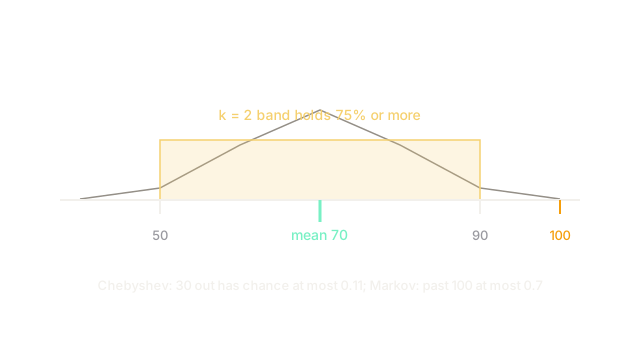
In plain words: straying deviations out has chance at most . At at least 75 percent sits inside two sigma; at at least 89 percent sits inside three. Chebyshev is Markov applied to the squared deviation , which is why the variance appears and why it binds both tails at once.
Worked example
Test scores average with standard deviation , shape unknown.
Markov on exceeding 100: . Weak but free: it used only the mean.
Chebyshev on straying 30 points either way: . Same data plus one variance, and the cap drops from 0.7 to 0.11. The reading: at least of scores land in , whatever the shape. If scores were known Gaussian the true two-sigma share would be about 95 percent, showing both the price of universality and its value: 75 percent holds for every distribution ever met.
Watch Out For
Quoting the bound as an estimate
At most 0.11 is not approximately 0.11. Real tails are usually far smaller, and sizing buffers or thresholds to the bound wastes capacity by multiples. Bounds certify worst cases; estimates need shape assumptions or data. Promising the bound as the forecast is how systems get overbuilt and how papers get misread.
Applying Markov to variables that go negative
Markov needs nonnegativity, and returns, errors, and centered variables violate it. The classic failure applies it to directly, where negatives cancel in the mean and the accounting collapses. Shift first, square first, or reach for Chebyshev: the squared deviation is always nonnegative, which is exactly why Chebyshev inherits no such restriction.
The Quick Version
- Markov caps one-sided exceedance with the mean alone: P(X past a) is at most mean over a.
- Chebyshev caps two-sided straying with mean and variance: past k sigma has chance at most 1 over k squared.
- Mean 70 and deviation 10 put at most 0.11 of mass 30 points out, and at least 75 percent inside two sigma.
- The bounds hold for every shape, which is their power and why they stay loose.
- Bounds certify worst cases; they never estimate typical ones.