Phase Portraits
The whole flow drawn at once: every arrow, every trajectory, and the fixed points organizing them, so long-run fate is visible before integrating.
Why Does This Exist?
Integrating one trajectory answers where one start goes. Design and debugging need all starts: which regions drain where, which cycles trap, where separatrices divide fates. A phase portrait compresses the whole flow into one picture: the vector field as arrows plus representative trajectories plus nullclines and equilibria. Reading it replaces dozens of integrations and exposes bifurcations, basins, and oscillations at a glance. Arrow language is in vector fields; verdicts on the equilibria use stability and fixed points.
The one idea you need first
At each state, is an arrow. Nullclines are curves where one component vanishes ( or ); their crossings are equilibria. Trajectories thread the arrows without ever crossing each other.
Think of It Like This
A weather map with streamlines
A weather map shows wind barbs everywhere plus a few drawn streamlines threading them. Highs and lows (equilibria) organize the picture: air spirals out of highs, into lows, and jet streams (separatrices) divide regimes. One glance says whether tomorrow's air over your city came from the desert or the sea, without integrating any parcel.
Phase portraits do the same for dynamics: arrows are the barbs, trajectories are the streamlines, fixed points are the highs and lows, and nullclines are the fronts where one wind component dies. The portrait answers "where from, where to" for every start at once.
Where the analogy stops: weather evolves in time itself, while an autonomous portrait is frozen: same arrows forever, so trajectories cannot merge or split.
How It Actually Works
Construct. Grid the arrows of , mark nullclines ( in one colour, in another), dot the equilibria at crossings, linearize each for type (node, spiral, saddle, center), and integrate a handful of starts per region to reveal basins and cycles.
Read. Closed isolated loops are limit cycles (check stability from inside and out); separatrices are trajectories bounding basins; spirals versus nodes come from complex versus real eigenvalue pairs. Direction matters as much as shape: same ellipse clockwise versus counter-clockwise is a different system.
Dimension caveat. Planes show everything; 3-D needs sections and projections that can hide crossings; high-D needs slices, Lyapunov exponents, or Poincaré maps rather than full portraits.
Worked example
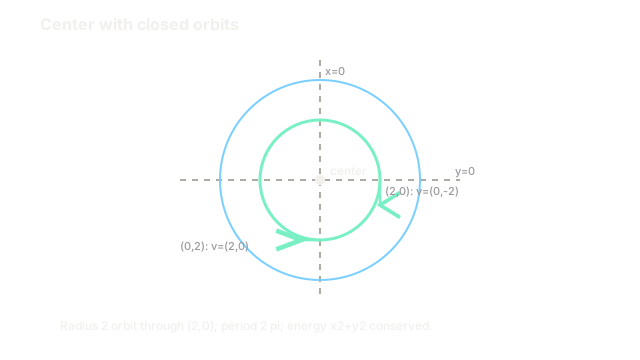
Harmonic oscillator , . Nullclines: on the -axis (), on the -axis (), crossing only at the origin: one equilibrium.
Energy is conserved (), so trajectories are circles . From : radius , period . Arrows: at the vector is (straight down); at it is (straight right): clockwise circulation. Linearization has eigenvalues : a center, stable but not attracting, and the portrait proves it globally since every orbit closes.
Watch Out For
Mistaking arrows for trajectories
Arrows show instantaneous direction; trajectories accumulate curvature. On coarse grids the eye connects arrows into false straightaways, missing spirals, and near saddles the arrow field looks calm exactly where fate is most sensitive.
Symptom: predicted fates that integration contradicts, especially near separatrices. Fix: always overlay integrated trajectories on the arrow grid, refine near equilibria and separatrices, and check nullcline crossings rather than eyeballing arrow convergence.
Trusting a projection as the portrait
Projecting 3-D or higher flows onto two axes lets trajectories cross, merge, and suggest equilibria that do not exist in the full system. A limit cycle can hide as a filled disc; chaos can look like noise.
Symptom: crossings in the picture (impossible for true autonomous planar flows) or portraits that change with viewing angle. Fix: use Poincaré sections for periodic structure, slice rather than project when possible, and treat any projected crossing as an artifact until proven otherwise.
The Quick Version
- Portraits combine arrow grids, nullclines, equilibria, and sample trajectories in one view.
- Nullcline crossings locate equilibria; linearization types them; trajectories reveal basins and cycles.
- The oscillator from circles radius 2 clockwise with period around a center.
- Overlay trajectories on arrows; coarse grids and projections both lie.
- Direction is data: same shape with reversed arrows is a different system.