Safety and Reliability in Physical AI
Physical AI systems operate in dynamic, human-shared environments where algorithmic failure carries real physical risk. True reliability is achieved not by trusting neural policies to never make mistakes, but through defense-in-depth: layering uncertified statistical models inside deterministic safety shields and certified hardware interlocks.
Why Does This Exist?
In digital software, an uncaught exception prints a stack trace to a log file. In web AI, a hallucinated sentence generates a mildly inaccurate response. But in Physical AI, an unhandled exception or an out-of-distribution neural output commands real motors with hundreds of Watts of electrical power, accelerating kilograms of steel and carbon fiber into human bodies, glassware, or factory machinery.
Many machine learning engineers assume that safety can be achieved by:
- Adding penalty terms to reinforcement learning reward functions ().
- Filtering text prompts in Vision-Language-Action models.
- Training on larger demonstration datasets.
These statistical approaches fail to deliver safety guarantees:
- Statistical models cannot certify safety: Deep neural networks are statistical function approximators. Even a model with 99.9% empirical success will encounter rare out-of-distribution camera glare, optical sensor dropout, or unseen object geometries that trigger erratic, full-torque commands.
- Reward penalties only minimize expected violations: In reinforcement learning, an agent balances task reward against collision penalties. If the expected reward for reaching a goal is high enough, the mathematical optimum will willingly accept a low-probability, catastrophic collision.
- Execution timing failures: If an operating system thread hangs for 50 milliseconds while garbage-collecting GPU memory, a mobile robot cruising at travels without active control.
Engineering reliable Physical AI requires defense-in-depth: an architectural discipline where high-level learned policies are strictly treated as untrusted suggestion engines, encapsulated inside independent, deterministic safety shields and certified hardware interlocks.
Think of It Like This
Think of safety in Physical AI like the flight control architecture of a commercial passenger jet.
Modern jetliners have sophisticated autopilot and flight management computers (analogous to learned policies or planners). The autopilot optimizes fuel efficiency, calculates comfortable climb profiles, and tracks GPS waypoints across oceans.
However, no aviation authority allows an autopilot to have unconstrained authority over the plane's control surfaces. Underneath the autopilot sits an independent flight envelope protection system:
- If the autopilot commands an aggressive pitch angle that would stall the wings, the low-level flight computer physically ignores the command and pushes the control stick forward.
- If the flight computer crashes, a secondary redundant backup computer takes over within milliseconds.
- If all avionics lose electrical power, physical mechanical cables and hydraulic accumulators allow the human pilots to flare the elevators and land the plane.
The airliner is not safe because its high-level autopilot software is bug-free. It is safe because catastrophic failure of the high-level software is caught by independent lower tiers that enforce non-negotiable physical laws.
Where the analogy stops: Commercial airplanes operate in regulated, open air corridors miles away from obstacles, following predictable flight paths. Service robots and physical AI agents operate in cluttered, human-dense homes, kitchens, and hospitals, interacting with fragile objects at zero clearance margins.
How It Actually Works
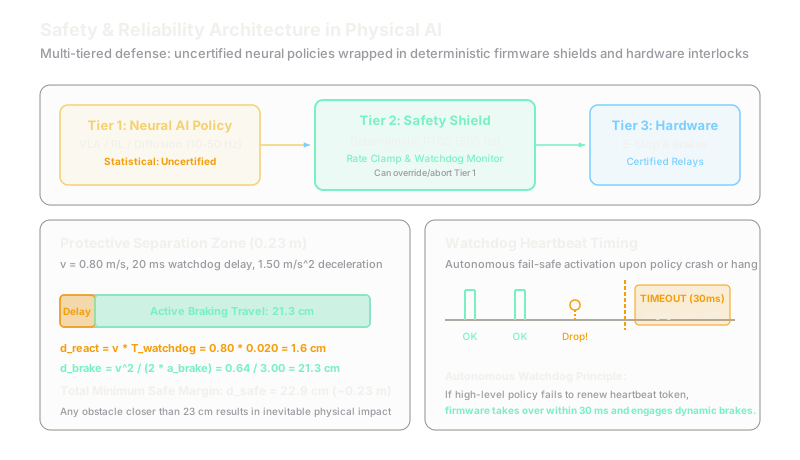
A robust physical AI system organizes its compute and control execution into three strictly decoupled tiers:
[Tier 1: High-Level AI Policy] (Uncertified, Statistical: 10-50 Hz) │ (Proposes Action Setpoint) ▼[Tier 2: Real-Time Safety Shield] (Deterministic RTOS / Microcontroller: 500 Hz) ├─ Heartbeat Watchdog Monitor ├─ Workspace & Velocity Clamps └─ Safe Deceleration Envelope │ (Verified Safe Commands) ▼[Tier 3: Hardware Interlocks] (Fail-Safe Physical Relays) ├─ Emergency Stop (E-Stop) Circuit └─ Spring-Loaded Dynamic Motor Brakes1. The Multi-Tier Defense
- Tier 1: High-Level Learned Policy (Statistical, Uncertified): Consumes multi-view camera streams, point clouds, and language instructions. Outputs high-level desired Cartesian paths, target grasp poses, or end-effector velocity targets at . This tier is explicitly assumed to be capable of crashing, hanging, or hallucinating.
- Tier 2: Real-Time Safety Shield (Deterministic, Certified): Runs on a real-time operating system (RTOS) or dedicated microcontroller at to . It evaluates proposed commands against physical invariants: joint velocity limits, acceleration bounds, torque limits, self-collision geometries, and LiDAR-derived protective separation zones. If Tier 1 proposes an unsafe command, Tier 2 projects the action onto the nearest safe boundary or triggers a controlled stop.
- Tier 3: Hardware Interlocks (Fail-Safe Physical): Independent electrical circuits, physical emergency stop (E-stop) mushroom buttons, and normally-closed electro-mechanical relays. If electrical power is cut or safety bus communication drops, spring-loaded friction brakes clamp the joints mechanically.
2. Protective Separation Distance Mathematics
For an autonomous mobile robot or manipulator operating around obstacles or humans, the safety shield maintains a minimum protective separation distance :
The vehicle or end-effector travels at velocity . If an obstacle enters the sensor field, the total distance traveled before the robot comes to a complete physical stop consists of two distinct components:
- Reaction displacement (): Distance traveled while the system detects the hazard, runs the safety watchdog, and commands the motor drives to engage brakes:
- Physical braking distance (): Distance traveled while decelerating at maximum emergency braking rate :
The total minimum separation distance required to guarantee zero contact is:
If an unmodeled obstacle or human limb is detected closer than , physical collision is inevitable—no software intervention can overcome Newtonian inertia.
3. Worked Example: Mobile Manipulator Separation Zone
Consider an autonomous warehouse mobile robot operating in a shared human corridor.
- Cruising speed: ().
- Safety watchdog timeout and brake response latency: .
- Emergency deceleration capability: .
Compute the reaction displacement during the watchdog detection window:
Compute the physical braking distance:
Compute total required protective separation distance:
The deterministic safety shield configures the LiDAR scanner to maintain an active protective zone around the vehicle chassis. If any obstacle breaches this perimeter, Tier 2 overrides the AI policy and triggers full emergency braking.
Code
The following Python script implements a production-grade Tier 2 safety monitor that supervises high-level AI policy commands using a watchdog timer and protective stopping distance calculation:
from dataclasses import dataclassimport timefrom typing import Optional, Tuple
@dataclassclass PolicyCommand: timestamp: float target_velocity: float # m/s joint_target: float # rad
class SafetyShieldMonitor: """Deterministic Tier 2 safety supervisor for uncertified AI policies."""
def __init__( self, watchdog_timeout_sec: float = 0.030, # 30 ms heartbeat max_deceleration: float = 1.50, # m/s^2 max_allowed_speed: float = 1.20, # m/s ) -> None: self.watchdog_timeout = watchdog_timeout_sec self.max_decel = max_deceleration self.max_speed = max_allowed_speed self.last_heartbeat: float = 0.0 self.safety_tripped: bool = False
def compute_protective_distance(self, current_velocity: float) -> float: """Calculates minimum stopping distance including reaction delay and braking.""" v = abs(current_velocity) d_react = v * self.watchdog_timeout d_brake = (v ** 2) / (2.0 * self.max_decel) return d_react + d_brake
def process_policy_heartbeat( self, command: Optional[PolicyCommand], current_time: float, current_velocity: float, closest_obstacle_dist: float, ) -> Tuple[float, str]: """Supervises the proposed command and returns safe velocity command and state.""" # Check 1: Watchdog Heartbeat if command is None or (current_time - command.timestamp) > self.watchdog_timeout: self.safety_tripped = True return 0.0, "TRIP_WATCHDOG_TIMEOUT: Engaging active brakes"
# Check 2: Minimum Protective Separation Margin safe_margin = self.compute_protective_distance(current_velocity) if closest_obstacle_dist <= safe_margin: self.safety_tripped = True return 0.0, f"TRIP_PROXIMITY: Obstacle at {closest_obstacle_dist:.3f}m <= safe {safe_margin:.3f}m"
# Check 3: Velocity Clamp clamped_vel = max(-self.max_speed, min(self.max_speed, command.target_velocity))
self.last_heartbeat = current_time self.safety_tripped = False return clamped_vel, "STATE_NORMAL: Command verified safe"
# Verify with worked example valuesmonitor = SafetyShieldMonitor(watchdog_timeout_sec=0.020, max_deceleration=1.50)
# At 0.80 m/s, required clearance is 0.016 + 0.2133 = 0.2293 m (~0.23 m)req_dist = monitor.compute_protective_distance(current_velocity=0.80)print(f"Protective distance required: {req_dist:.4f} m")assert abs(req_dist - 0.2293) < 1e-3
# Case 1: Obstacle at 0.30 m (Safe clearance)cmd = PolicyCommand(timestamp=10.000, target_velocity=0.80, joint_target=0.5)safe_vel, status = monitor.process_policy_heartbeat( cmd, current_time=10.010, current_velocity=0.80, closest_obstacle_dist=0.30)assert safe_vel == 0.80print(f"Case 1: {status}")
# Case 2: Obstacle breaches boundary at 0.20 m (< 0.2293 m)safe_vel, status = monitor.process_policy_heartbeat( cmd, current_time=10.010, current_velocity=0.80, closest_obstacle_dist=0.20)assert safe_vel == 0.0assert monitor.safety_tripped is Trueprint(f"Case 2: {status}")
# Case 3: Policy hangs (Heartbeat drops for 25 ms > 20 ms timeout)safe_vel, status = monitor.process_policy_heartbeat( cmd, current_time=10.025, current_velocity=0.80, closest_obstacle_dist=0.50)assert safe_vel == 0.0assert monitor.safety_tripped is Trueprint(f"Case 3: {status}")Watch Out For
Relying on reinforcement learning reward penalties for safety certification
During simulation training, penalties like for collision encourage the policy to avoid obstacles in training runs. However, neural networks output actions based on probabilistic distribution sampling.
The symptom is deploying an RL policy that operates cleanly for 100 hours, then suddenly drives full-speed into a reflective glass wall because afternoon sunlight created a visual observation not present in training. A reward function penalty does not establish an invariant boundary. Fix this by never letting learned RL actions bypass a deterministic Tier 2 kinematic and dynamic safety filter: enforce hard spatial bounding boxes and maximum velocity curves in firmware.
Routing emergency stop signals through operating system software networks
Connecting an E-Stop button or proximity sensor as a software interrupt or ROS 2 network topic over Wi-Fi or Ethernet.
The symptom is pressing the emergency stop button during a runaway arm event, but the arm continues moving for 300 milliseconds because a network buffer was congested or the operating system was page-swapping. Software cannot be trusted with life safety. Fix this by wiring emergency stop buttons directly to certified, normally-closed hardware safety relays that physically disconnect DC motor bus power or short motor windings for dynamic braking.
The Quick Version
- Physical AI safety cannot be solved solely by training larger neural models or adding reward penalties; statistical systems will always encounter out-of-distribution edge cases.
- Defense-in-depth separates responsibilities into three decoupled tiers: uncertified AI policy (), deterministic safety shield (), and certified hardware interlocks.
- The minimum protective separation distance accounts for reaction latency and physical braking: .
- At with a watchdog delay and braking deceleration, stopping requires at least () of unobstructed space.
- Heartbeat watchdogs ensure that if a GPU policy crashes or hangs for more than , real-time firmware instantly takes over and engages fail-safe deceleration.