Advanced RL Paradigms
Advanced reinforcement learning transcends single-task trial-and-error by structuring learning through hierarchy, multi-agent coordination, curiosity-driven exploration, and meta-learning.
Why Does This Exist?
Standard single-agent reinforcement learning frames intelligence as an agent mapping states to primitive motor actions via a single flat policy in a stationary Markov Decision Process. While effective for video games with dense rewards, this baseline framing collapses when exposed to four fundamental real-world barriers:
- Extreme Temporal Horizons & Sparse Rewards: If a reward is only awarded after 100,000 steps (such as assembling an engine or solving Montezuma's Revenge), random exploration has virtually zero probability of stumbling onto success.
- Non-Stationary Environments: In multi-agent ecosystems (warehouse robotics, autonomous fleets), other agents adapt their policies simultaneously, violating the fundamental MDP assumption that transition dynamics are fixed.
- Exploration Inefficiencies: In environments with no extrinsic reward signals, flat agents remain paralyzed or twitch aimlessly in place.
- Task Generalization Bottlenecks: A standard RL policy trained to navigate a maze must restart learning from scratch when walls shift slightly.
Advanced RL paradigms expand the formulation of the problem itself. By introducing temporal hierarchy, multi-agent coordination frameworks, self-supervised curiosity rewards, and meta-learning, these architectures scale RL from toy simulations to complex open-ended systems.
Think of It Like This
A corporate organization from executive strategy to ground-level tasks
Imagine running an international logistics enterprise using flat reinforcement learning. That would mean the Chief Executive Officer must personally issue thousands of micro-commands every second: "Contract left index finger around steering wheel, apply 4 Newtons of pressure to brake pedal, adjust mirror 2 degrees." Attempting to control a multi-national company at the level of individual muscle twitches guarantees complete operational failure.
Real organizations operate through advanced hierarchical and multi-agent structures:
- The CEO operates as a Hierarchical Meta-Policy, setting macro-objectives across multi-month horizons: "Open distribution center in Chicago."
- Regional managers and drivers operate as Low-Level Sub-Policies, executing primitive actions until that specific sub-goal is achieved.
- Multiple drivers coordinate via Decentralized Execution, observing their local windshields while dispatch relies on a centralized view.
- Research teams are driven by Curiosity, rewarded for exploring unknown market niches even before customer contracts arrive.
How It Actually Works
Hierarchies, Intrinsic Curiosity, and Multi-Agent Coordination
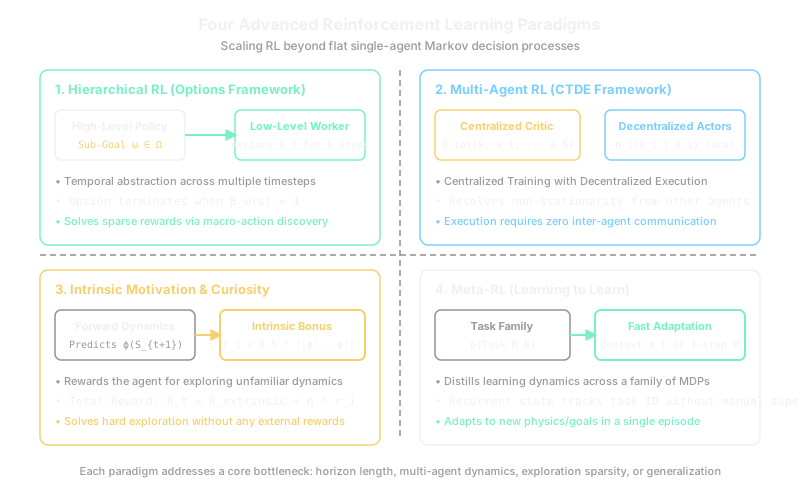
Advanced RL decomposes monolithic control into four specialized structural frameworks:
1. Hierarchical RL & The Options Framework (Sutton, Precup & Singh, 1999)
An option represents a temporally extended macro-action defined by a 3-tuple :
- Initiation Set : States where the option can be launched.
- Internal Policy : Maps states to primitive actions while the option is active.
- Termination Function : The probability that the option finishes in state .
A high-level policy over options chooses an option, which executes for timesteps until , converting the problem into a Semi-Markov Decision Process (SMDP).
2. Multi-Agent Centralized Training with Decentralized Execution (CTDE)
In multi-agent systems with agents, training independent Q-learners fails because from Agent 1's perspective, the environment is non-stationary as Agent 2 updates its policy.
Under CTDE (e.g., QMIX, MAPPO):
- During Training: A centralized Critic has access to the full joint state and all joint actions , computing a centralized total value .
- During Execution: Individual agents execute decentralized policies conditioned strictly on their local observation , requiring zero runtime inter-agent communication.
3. Intrinsic Curiosity Module (ICM) (Pathak et al., 2017)
In reward-sparse environments, the agent generates its own intrinsic reward driven by prediction error over environment dynamics.
An embedding network maps states to feature representations: . A forward dynamics network predicts next-state features given current features and executed action: . The intrinsic reward bonus is the mean squared prediction error:
The agent's total reward becomes:
Unfamiliar states generate high prediction error, incentivizing the agent to explore novel dynamics even when extrinsic reward is zero.
4. Meta-Reinforcement Learning (, MAML)
Instead of training on a single MDP, the agent trains across a distribution of tasks . By encoding past transitions into the recurrent hidden state of an LSTM or Transformer policy, the network "learns to learn", adapting to new transition dynamics within a single rollout episode without further weight updates.
Worked Example
An agent explores a labyrinth with zero extrinsic reward (). The agent utilizes an Intrinsic Curiosity Module with scaling hyperparameter . Discount factor .
At step , the agent takes action in state .
- Feature Extraction:
- The true next state passes through feature encoder :
- Forward Dynamics Prediction:
- The forward model predicts features based on and :
- Prediction Error Calculation:
- Error vector:
- Squared L2 norm:
- Intrinsic Reward Bonus:
- Combined Bellman Target: With and Critic estimate :
The curiosity bonus provided a non-zero training gradient that pulls the agent toward the unexplored corridor.
Code
from typing import Tupleimport numpy as np
def compute_curiosity_reward( phi_next_true: np.ndarray, phi_next_pred: np.ndarray, r_extrinsic: float = 0.0, eta: float = 0.5,) -> Tuple[float, float]: """Computes intrinsic curiosity bonus from forward model prediction error.""" # Squared L2 error between predicted and true feature representations diff = phi_next_pred - phi_next_true squared_error = float(np.sum(diff ** 2)) # Intrinsic curiosity reward r_intrinsic = (eta / 2.0) * squared_error r_total = r_extrinsic + r_intrinsic return r_intrinsic, r_total
# Features matching worked examplephi_true = np.array([1.0, 2.0, 0.0], dtype=np.float64)phi_pred = np.array([1.2, 1.6, 0.5], dtype=np.float64)
r_int, r_tot = compute_curiosity_reward( phi_next_true=phi_true, phi_next_pred=phi_pred, r_extrinsic=0.0, eta=0.5,)
print(f"Intrinsic Reward r_i: {r_int:.4f}")# -> Intrinsic Reward r_i: 0.1125
print(f"Total Combined Reward: {r_tot:.4f}")# -> Total Combined Reward: 0.1125Watch Out For
The Noisy TV Problem in Intrinsic Curiosity
When intrinsic motivation rewards forward prediction error, agents become hypnotized by stochastic noise sources that cannot be predicted. If an agent encounters a television screen displaying random static (white noise) in a simulated room, the next static frame is fundamentally unpredictable. Because the forward prediction error never drops to zero, the agent earns infinite curiosity rewards by staring at the screen forever, completely abandoning its primary mission.
To eliminate the Noisy TV trap, avoid raw pixel prediction errors. Use Random Network Distillation (RND), where curiosity is measured by how well a trained network predicts the output of a fixed, randomized target network. Alternatively, employ inverse dynamics features that discard un-controllable environmental background noise.
The Quick Version
- Hierarchical RL divides decision-making into multi-step options () managed by a meta-policy, solving sparse long-horizon credit assignment.
- Multi-Agent RL uses Centralized Training with Decentralized Execution (CTDE) to stabilize learning while keeping execution independent.
- Intrinsic Curiosity rewards agents for predicting forward dynamics errors (), driving exploration in zero-reward environments.