Asynchronous Dynamic Programming
Updates states individually in-place rather than sweeping the entire state space in rigid lockstep, propagating new values immediately and cutting computation.
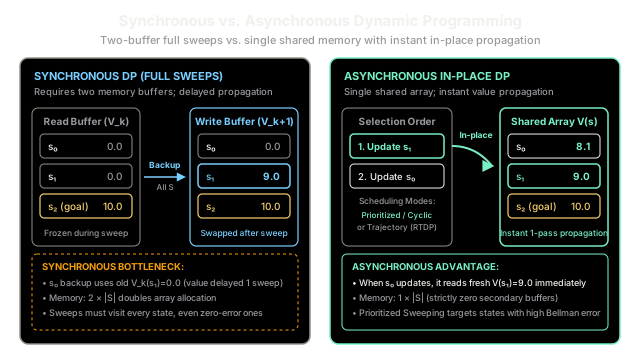
Why Does This Exist?
Classical Dynamic Programming (DP) algorithms—such as standard Value Iteration and Policy Iteration—rely on synchronous sweeps. To compute the value function for iteration , the algorithm must iterate systematically across every single state in the environment, using values stored in a frozen buffer from iteration .
In practice, this synchronous approach breaks down across three critical axes:
- Wasted Computation on Irrelevant States: In large Markov Decision Processes (MDPs) containing millions or billions of states (e.g., board games, robotics, routing), performing an exhaustive sweep across the entire state space is computationally prohibitive. Many states are rarely or never reachable from realistic starting conditions, yet synchronous DP spends equal computational budget updating all of them.
- Buffer Memory Duplication: Synchronous updates require two separate value arrays: a read-only buffer and a write buffer . Memory must be allocated twice, and new estimates cannot be stored in-place until the entire sweep across all states concludes.
- High Backup Latency: Because updates are locked into rigid batches, a newly discovered reward at a goal state cannot propagate backward to upstream predecessor states within the same iteration. If an optimal trajectory spans transitions, synchronous value iteration requires at least complete passes over the entire state space before the reward signal reaches the start state.
Asynchronous Dynamic Programming breaks this rigid lockstep. Instead of exhaustive batch sweeps, it updates state values individually in arbitrary or targeted sequences directly inside a single shared memory buffer. States that change quickly or appear on critical trajectories receive immediate computational attention, while value improvements propagate immediately across downstream backups.
Think of It Like This
Cleaning a mansion room by room vs. rigid whole-house vacuuming
Imagine managing a 50-room mansion.
Under a synchronous cleaning protocol, you must vacuum and dust every single room in a strict numerical sequence (Room 1 through Room 50) before declaring "Pass 1" complete. Even if nobody has entered the attic or the third-floor storage closet in months, you must inspect and vacuum them before you are permitted to re-clean the mudroom where guests are tracking in snow. Furthermore, nobody is allowed to walk on the newly vacuumed foyer until every other room in the mansion has finished its pass.
Asynchronous dynamic programming is spot-cleaning on demand:
- When guests track mud into the foyer, you immediately clean the foyer (in-place update).
- Someone walking into the living room immediately benefits from the clean foyer without waiting for the attic inspection (instant value propagation).
- You can prioritize high-traffic rooms like the kitchen and hallways while rarely visiting locked guest rooms (prioritized sweeping / real-time updates).
- You only need one set of cleaning supplies in active circulation rather than staging double sets of furniture (single-buffer memory).
Where the analogy breaks: In physical cleaning, sweeping the kitchen does not magically change the amount of dirt in the living room. In reinforcement learning, state values are mathematically coupled through the Bellman equations: updating the value of state immediately changes the Bellman backup target for all predecessor states that transition into .
How It Actually Works
In-Place Iterative Updates Without Separate Buffers
Let an MDP be defined by the tuple , where is the discrete state space, is the action space, is the joint transition and reward probability distribution, and is the discount factor.
The optimal state-value function satisfies the Bellman optimality equation:
In synchronous Value Iteration, two distinct memory vectors and are maintained:
In asynchronous dynamic programming, values are backed up in-place into a single shared array :
Here, is whichever state is selected at time step . When is updated, its old value is immediately overwritten. If an adjacent predecessor state is evaluated at step , it reads the fresh value directly, allowing value updates to cascade within a single pass.
State Selection Orders and Convergence Guarantees
Asynchronous DP is not a single rigid algorithm, but a general framework governed by how states are chosen for updates. The three most common paradigms are:
-
In-Place Value Iteration (Arbitrary or Cyclic Sweeps): The algorithm iterates through states in a fixed cyclic order () or samples states uniformly at random. Because fresh updates overwrite memory in-place, values propagate faster than synchronous buffers without requiring extra bookkeeping.
-
Prioritized Sweeping: Updates are scheduled based on the magnitude of the Bellman error (or Bellman residual): States with the highest error are stored in a priority queue (max-heap). When the top state is updated, its immediate predecessors (all states that can transition into ) have their Bellman errors recalculated and pushed onto the queue if , focusing computation strictly where values are actively changing.
-
Real-Time Dynamic Programming (RTDP): Backups occur concurrently with an agent's actual experience trajectories. At the current state , the agent runs an in-place Bellman backup on , selects a greedy action , transitions to , and repeats. Irrelevant states that cannot be reached under the optimal policy from the start state are ignored entirely.
Convergence Theorem
Bertsekas and Tsitsiklis established the formal convergence criterion for asynchronous dynamic programming:
Theorem (Asynchronous DP Convergence): For a discounted MDP with and bounded rewards, if every state is updated infinitely often:
then for any arbitrary initial value vector , the asynchronous value sequence converges to the unique optimal value function:
Because the Bellman optimality operator remains a contraction mapping under the infinity norm (), asynchronous updates never diverge, even with arbitrary update orders and bounded communication delays.
Worked numerical example
Consider a 3-state deterministic linear corridor MDP:
- States: where is an absorbing terminal goal state ().
- Actions: A single action .
- Transitions and Rewards:
- From : transitions to with immediate reward .
- From : transitions to with immediate reward .
- Discount factor: .
- Initial estimates: , , .
The true optimal values are:
Step 1: Synchronous Sweep (Two Buffers: )
Sweep 1: Reads exclusively from :
- Update :
- Update :
- Result after Sweep 1: . (Notice: State learned nothing about the reward because it read from frozen .)
Sweep 2: Reads from :
- Update :
- Update :
- Result after Sweep 2: (Converged).
Synchronous Cost: 2 full sweeps, 4 total state backups.
Step 2: Asynchronous In-Place Update (Single Shared Buffer )
Single array initialized to . Suppose we update in reverse topological order (, then ):
-
Update in-place: Shared memory is immediately overwritten: .
-
Update in-place: Shared memory is immediately overwritten: .
Asynchronous Cost: In just 1 pass of 2 total state backups, the value signal propagated from the goal all the way to start state , achieving exact convergence in half the operations.
Code
import heapqfrom typing import Dict, List, Tuple
class ChainMDP: """A linear chain MDP where an agent navigates toward a terminal goal state."""
def __init__(self, n_states: int = 5, goal_reward: float = 10.0, gamma: float = 0.9) -> None: self.n_states = n_states self.terminal_state = n_states - 1 self.gamma = gamma self.actions = [0, 1] # 0: stay, 1: step right self.transitions: Dict[Tuple[int, int], List[Tuple[float, int, float]]] = {}
for s in range(self.terminal_state): # Action 0: stay in place (reward 0.0) self.transitions[(s, 0)] = [(1.0, s, 0.0)] # Action 1: step right (reward 10.0 if reaching terminal state, else 0.0) next_state = s + 1 reward = goal_reward if next_state == self.terminal_state else 0.0 self.transitions[(s, 1)] = [(1.0, next_state, reward)]
def bellman_backup(self, s: int, V: List[float]) -> float: """Computes max_a sum_{s', r} p(s', r | s, a) [r + gamma * V(s')].""" if s == self.terminal_state: return 0.0 q_values: List[float] = [] for a in self.actions: q = sum( prob * (reward + self.gamma * V[next_s]) for prob, next_s, reward in self.transitions[(s, a)] ) q_values.append(q) return max(q_values)
def sync_value_iteration(mdp: ChainMDP, theta: float = 1e-4) -> Tuple[List[float], int, int]: """Synchronous Value Iteration maintaining dual read/write buffers.""" V = [0.0] * mdp.n_states sweeps = 0 backups = 0
while True: sweeps += 1 V_new = V.copy() # Frozen buffer for read operations delta = 0.0 for s in range(mdp.terminal_state): v_val = mdp.bellman_backup(s, V) backups += 1 delta = max(delta, abs(v_val - V[s])) V_new[s] = v_val
V = V_new if delta < theta: break
return V, sweeps, backups
def async_inplace_value_iteration( mdp: ChainMDP, reverse: bool = True, theta: float = 1e-4) -> Tuple[List[float], int, int]: """Asynchronous Value Iteration updating directly in a single shared buffer.""" V = [0.0] * mdp.n_states sweeps = 0 backups = 0 state_order = list(reversed(range(mdp.terminal_state))) if reverse else list(range(mdp.terminal_state))
while True: sweeps += 1 delta = 0.0 for s in state_order: old_v = V[s] V[s] = mdp.bellman_backup(s, V) # In-place overwrite backups += 1 delta = max(delta, abs(V[s] - old_v))
if delta < theta: break
return V, sweeps, backups
def async_prioritized_sweeping(mdp: ChainMDP, theta: float = 1e-4) -> Tuple[List[float], int]: """Asynchronous Prioritized Sweeping queueing states by Bellman error magnitude.""" V = [0.0] * mdp.n_states backups = 0
# Build predecessor map: next_state -> set of states that can reach it predecessors: Dict[int, List[int]] = {s: [] for s in range(mdp.n_states)} for s in range(mdp.terminal_state): predecessors[s].append(s) # Action 0 (stay) predecessors[s + 1].append(s) # Action 1 (step right)
# Initialize priority queue with states having non-zero error pq: List[Tuple[float, int]] = [] for s in range(mdp.terminal_state): err = abs(mdp.bellman_backup(s, V) - V[s]) if err > theta: heapq.heappush(pq, (-err, s))
while pq: neg_err, s = heapq.heappop(pq) V[s] = mdp.bellman_backup(s, V) backups += 1
# Check predecessors and push them if their error exceeds theta for p in set(predecessors[s]): if p == mdp.terminal_state: continue p_err = abs(mdp.bellman_backup(p, V) - V[p]) if p_err > theta: heapq.heappush(pq, (-p_err, p))
return V, backups
if __name__ == "__main__": env = ChainMDP(n_states=5, goal_reward=10.0, gamma=0.9)
v_sync, sync_sweeps, sync_backups = sync_value_iteration(env) v_async, async_sweeps, async_backups = async_inplace_value_iteration(env, reverse=True) v_prio, prio_backups = async_prioritized_sweeping(env)
print("=== Dynamic Programming Benchmark ===") print(f"Synchronous DP: {sync_sweeps} sweeps, {sync_backups} backups -> V = {[round(x, 2) for x in v_sync]}") print(f"Asynchronous In-Place: {async_sweeps} sweeps, {async_backups} backups -> V = {[round(x, 2) for x in v_async]}") print(f"Prioritized Sweeping: N/A sweeps, {prio_backups} backups -> V = {[round(x, 2) for x in v_prio]}")Execution Output
=== Dynamic Programming Benchmark ===Synchronous DP: 5 sweeps, 20 backups -> V = [7.29, 8.1, 9.0, 10.0, 0.0]Asynchronous In-Place: 2 sweeps, 8 backups -> V = [7.29, 8.1, 9.0, 10.0, 0.0]Prioritized Sweeping: N/A sweeps, 4 backups -> V = [7.29, 8.1, 9.0, 10.0, 0.0]Watch Out For
State starvation breaks convergence guarantees
The central theorem of asynchronous dynamic programming guarantees convergence to if and only if every reachable state continues to be updated infinitely often.
When engineers implement custom scheduling heuristics or online trajectory backups (such as Real-Time Dynamic Programming), a common failure mode is state starvation: the agent strictly follows a myopic greedy policy, updating only the states along its current trajectory while completely ignoring alternate branches.
Symptom: The value function appears to converge rapidly with near-zero Bellman residual along visited paths, but the derived policy remains locked in a catastrophic sub-optimal attractor or infinite loop because unexplored shortcut states retain stale or zero values.
Concrete Fix:
- In RTDP or trajectory-based methods, inject an exploration mechanism such as an -greedy exploratory policy during rollout backups.
- In prioritized sweeping, maintain a non-zero minimum priority or interleave occasional uniform background sweeps across all reachable states to guarantee full coverage.
The Quick Version
- Synchronous DP sweeps every state in lockstep: It evaluates the full state space using dual memory buffers (), delaying reward propagation across upstream states by entire iterations.
- Asynchronous DP updates in-place: Backups occur individually into a single shared array, cutting memory consumption in half and propagating new values immediately to subsequent updates.
- Order matters for efficiency: Practitioners can update states via cyclic sweeps, prioritized sweeping (ordered by Bellman error magnitude in a heap), or trajectory sampling (RTDP).
- Convergence is guaranteed: As long as the discount factor and every state is visited infinitely often, asynchronous DP mathematically converges to the true optimal .
- Avoid state starvation: Selective or heuristic updating must never permanently neglect reachable states, or global convergence guarantees will fail.