Conservative Q-Learning (CQL)
Conservative Q-Learning prevents offline reinforcement learning overestimation by adding an explicit penalty on unobserved actions. By penalizing out-of-distribution values while pushing up on in-dataset transitions, CQL learns a provable lower bound on the true value function.
Why Does This Exist?
In offline reinforcement learning (also termed batch RL), an agent must learn an optimal policy solely from a fixed historical dataset generated by unknown behavior policies . Physical trial-and-error is prohibited.
When classical off-policy algorithms such as DQN, DDPG, or Soft Actor-Critic (SAC) are trained on fixed offline datasets, they fail catastrophically. The root cause is distributional shift coupled with the Bellman optimality operator:
Because deep neural networks are unconstrained function approximators, they do not output zero on actions absent from the dataset (). Instead, random parameter initialization and gradient noise create spurious, highly positive extrapolation spikes in out-of-distribution (OOD) action regions.
When computing target values , the operator greedily selects the highest hallucinated value spike. In subsequent Bellman updates, these inflated targets become ground truth, propagating recursively across training steps until estimated Q-values explode to hundreds of times their true values. When deployed on physical hardware, the resulting policy seeks out these hallucinated spikes, executing actions that result in crashes or operational shutdown.
Existing policy-constraint methods (such as BCQ and BEAR) attempt to mitigate this by estimating the behavior policy with generative models (like Variational Autoencoders) and restricting policy updates to supported actions. However, learning accurate density models in high dimensions is challenging and compounds estimation errors.
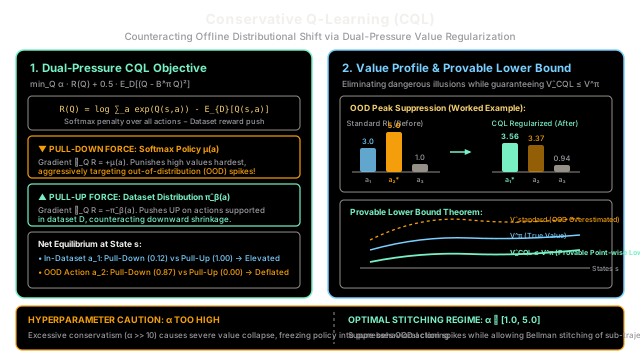
Conservative Q-Learning (CQL), developed by Kumar et al. (NeurIPS 2020), resolves this pathology directly within the value function. Rather than constraining the policy, CQL adds an explicit regularizer to the Critic's Bellman loss that pulls down unobserved action values while pushing up on actions present in the dataset. This dual-pressure mechanism guarantees that the learned value function is a provable point-wise lower bound on the true value function, completely eliminating overestimation error by construction.
Think of It Like This
An ultra-conservative structural engineer rating a bridge's load capacity
Imagine two structural engineers tasked with certifying the maximum load rating of an old steel bridge purely from a historical ledger of past vehicle crossings (a fixed offline dataset ).
The standard off-policy engineer fits an unconstrained polynomial regression model to the ledger. The ledger shows 5-ton delivery vans and 10-ton buses crossed safely. However, because no 60-ton multi-trailer freight truck ever crossed the bridge, there is zero negative evidence in the ledger. The unconstrained curve extrapolates wildly into the untested 60-ton zone: "My equation predicts that a 60-ton freight truck has a safety margin of +500%!" When the first real freight truck rolls onto the bridge during live deployment, the bridge collapses into the river.
The Conservative Q-Learning engineer enforces rigorous safety margins:
- For vehicle weights documented in the ledger (in-distribution actions), the engineer uses empirical measurements (standard Bellman temporal difference error).
- For unverified, out-of-distribution vehicle configurations (the Log-Sum-Exp penalty), the engineer applies an aggressive downward safety penalty.
- The highest speculative estimates are punished the hardest: an untested 60-ton truck receives a massive downward penalty that pushes its rated capacity far below that of verified buses.
By design, the certified capacity is guaranteed to be strictly less than or equal to the bridge's true physical capacity (). The bridge never collapses because the engineer refuses to reward ungrounded optimism.
Where the analogy stops: bridge weight ratings are scalar thresholds on static steel structures, whereas reinforcement learning requires sequential temporal credit assignment over thousands of steps, where the agent must stitch together sub-optimal trajectories from diverse historical drivers into an optimal end-to-end path.
How It Actually Works
Conservative Value Regularization and the Provable Lower Bound
Conservative Q-Learning augments the standard Bellman Mean Squared Error (MSE) objective with an explicit value regularizer weighted by hyperparameter :
where is the empirical Bellman evaluation operator.
┌────────────────────────────────────────────────────────┐ │ The CQL Critic Loss │ └───────────────────────────┬────────────────────────────┘ │ ┌────────────────────────────────────┴────────────────────────────────────┐ │ │┌────────▼────────────────────────────────────────┐ ┌──────────────────▼───────────────────┐│ Conservatism Regularizer α · R(Q) │ │ Standard Bellman MSE Loss ││ Dual-Pressure Mechanism: │ │ Matches verified transitions in D: ││ ▼ Pull-Down: log ∑_a exp(Q(s, a)) │ │ 0.5 · E_{(s,a,r,s')~D}[(Q - y)²] ││ ▲ Pull-Up: - E_{a~D}[Q(s, a)] │ │ Maintains temporal-difference credit │└─────────────────────────────────────────────────┘ └──────────────────────────────────────┘1. The Dual-Pressure Regularizer Formulations
Kumar et al. introduced two primary variants of the conservatism regularizer:
Formulation A: Policy-Targeted Regularizer CQL()
To prevent the current policy from overestimating values, CQL penalizes expected Q-values under an adversarial policy while rewarding Q-values under the dataset behavior policy :
Formulation B: Log-Sum-Exp Regularizer CQL()
In practical deep reinforcement learning, setting to an adversarial Boltzmann distribution under a maximum entropy constraint produces the closed-form Log-Sum-Exp regularizer:
In continuous action spaces where computing the exact sum over all actions is intractable, the Log-Sum-Exp term is approximated via importance sampling using actions sampled uniformly from the action space and actions sampled from the current policy :
2. Dual-Pressure Gradient Dynamics
To observe how CQL neutralizes out-of-distribution value spikes, examine the analytical gradient of the Log-Sum-Exp regularizer with respect to the Q-value of a specific state-action pair :
The gradient decomposes into two opposing forces:
- The Pull-Down Force (): The first term is the softmax probability of action under the current Q-values. Because pushes Q-values downward during gradient descent (), every action receives downward pressure. Actions with inflated Q-values receive exponentially larger softmax weight (), concentrating almost all downward pressure directly onto the most severe OOD peaks!
- The Pull-Up Force (): The second term is active only for actions present in the dataset . For an observed dataset action, introduces a negative gradient, which pushes its Q-value upward during gradient descent.
The Resulting Equilibrium
- For an In-Dataset Action : The pull-down force is counterbalanced by the pull-up force (). The regularizer cancels out, allowing the Bellman MSE loss to anchor the value accurately to empirical reward transitions.
- For an Out-of-Distribution Action : The action receives zero pull-up force (), but receives maximum pull-down force (). The Q-value is aggressively depressed until it drops safely below supported dataset actions.
3. The Provable Lower Bound Theorem
Kumar et al. (Theorem 3.2) proved that CQL produces a point-wise conservative lower bound on the true value function.
Theorem (CQL Provable Lower Bound): Let denote the -th iterate of the CQL evaluation operator under policy . If for a constant proportional to the maximum action divergence, then for all states and iterations :
where , and is the true discounted return of policy in the real environment.
This theorem guarantees that CQL will never overestimate the expected return of the learned policy. By substituting optimism in the face of uncertainty with provable conservatism, offline agents can be deployed safely without catastrophic value collapse.
Worked numerical example
To trace the mechanics of the dual-pressure regularizer, consider an agent evaluating decisions at state across three discrete actions: .
Environment and Dataset Setup
- The offline dataset contains transitions for action only:
- An unconstrained neural network has extrapolated the initial Q-values:
- (supported in dataset)
- (dangerous out-of-distribution spike!)
- (unsupported in dataset)
- The true Bellman target for the supported transition is .
- Hyperparameters: conservatism coefficient , learning rate .
Step 1: Log-Sum-Exp Calculation
Compute exponentials of the action values:
Sum of exponentials:
The Log-Sum-Exp value is:
Step 2: Regularizer Value
The conservatism regularizer objective is:
Step 3: Softmax Probabilities
Compute the adversarial softmax distribution:
Notice that : the regularizer automatically concentrates nearly all of its attention on punishing the OOD peak !
Step 4: Analytical Gradient Computation
Compute the regularizer gradient :
- For :
- For :
- For :
The Bellman MSE gradient is active only on the dataset action :
For and , because they do not appear in the dataset.
Step 5: Gradient Descent Update Step
Apply gradient descent with and :
- For :
- For :
- For :
After five consecutive update steps:
The hallucinated OOD peak drops from to , falling safely below the supported dataset action . The greedy policy now selects , completely neutralizing the out-of-distribution extrapolation trap.
Code
The following self-contained Python script implements the Conservative Q-Learning objective, computes exact Log-Sum-Exp regularizers and analytical gradients, verifies the worked numerical example, and tests convergence assertions.
from typing import Dict, Tupleimport numpy as np
class ConservativeQLearning: """Discrete-action Conservative Q-Learning (CQL) objective and optimizer."""
def __init__(self, alpha: float = 1.0, learning_rate: float = 0.5) -> None: self.alpha = alpha self.learning_rate = learning_rate
def compute_loss( self, q_values: np.ndarray, dataset_action_idx: int, bellman_target: float, ) -> Tuple[float, float, float]: """Computes CQL loss: Log-Sum-Exp penalty, dataset push, and Bellman MSE.""" # Log-Sum-Exp over all actions: log sum_a exp(Q(s, a)) log_sum_exp = float(np.log(np.sum(np.exp(q_values))))
# Dataset action Q-value: E_{a ~ pi_beta}[Q(s, a)] q_data = float(q_values[dataset_action_idx])
# Conservatism regularizer: R(Q) = log_sum_exp - q_data reg_cql = log_sum_exp - q_data
# Standard Bellman MSE error on dataset transition bellman_mse = 0.5 * float((q_data - bellman_target) ** 2)
# Combined CQL objective total_loss = self.alpha * reg_cql + bellman_mse return total_loss, reg_cql, bellman_mse
def compute_gradients( self, q_values: np.ndarray, dataset_action_idx: int, bellman_target: float, ) -> Dict[str, np.ndarray]: """Computes analytical gradients for Q-values under CQL objective.""" # Numerically stable softmax: mu(a) = exp(Q(s, a)) / sum_a exp(Q(s, a)) exp_q = np.exp(q_values - np.max(q_values)) mu = exp_q / np.sum(exp_q)
# Dataset one-hot distribution pi_beta pi_beta = np.zeros_like(q_values) pi_beta[dataset_action_idx] = 1.0
# Gradient of conservatism regularizer: nabla R = mu - pi_beta grad_reg = mu - pi_beta
# Gradient of Bellman MSE: active strictly for dataset action grad_bellman = np.zeros_like(q_values) grad_bellman[dataset_action_idx] = q_values[dataset_action_idx] - bellman_target
# Total combined gradient: alpha * grad_reg + grad_bellman total_grad = self.alpha * grad_reg + grad_bellman
return { "softmax_mu": mu, "grad_reg": grad_reg, "grad_bellman": grad_bellman, "total_grad": total_grad, }
def update_q_values( self, q_values: np.ndarray, dataset_action_idx: int, bellman_target: float, num_steps: int = 1, ) -> np.ndarray: """Applies gradient descent updates to suppress OOD values and satisfy Bellman targets.""" q = q_values.copy() for _ in range(num_steps): grads = self.compute_gradients(q, dataset_action_idx, bellman_target) q -= self.learning_rate * grads["total_grad"] return q
# --- Verification Matching Worked Example ---cql = ConservativeQLearning(alpha=1.0, learning_rate=0.5)initial_q = np.array([3.0, 5.0, 1.0], dtype=np.float64)dataset_action = 0 # a_1 is in datasetbellman_y = 3.0 # true target for a_1
grads = cql.compute_gradients(initial_q, dataset_action, bellman_y)
print(f"Softmax Policy mu: [{grads['softmax_mu'][0]:.4f}, {grads['softmax_mu'][1]:.4f}, {grads['softmax_mu'][2]:.4f}]")# -> Softmax Policy mu: [0.1173, 0.8668, 0.0159]
print(f"Regularizer Gradient: [{grads['grad_reg'][0]:.4f}, {grads['grad_reg'][1]:.4f}, {grads['grad_reg'][2]:.4f}]")# -> Regularizer Gradient: [-0.8827, 0.8668, 0.0159]
# Run 5 gradient descent stepsupdated_q = cql.update_q_values(initial_q, dataset_action, bellman_y, num_steps=5)
print(f"Initial Q: [{initial_q[0]:.2f}, {initial_q[1]:.2f}, {initial_q[2]:.2f}]")# -> Initial Q: [3.00, 5.00, 1.00]
print(f"Updated Q (5 steps): [{updated_q[0]:.2f}, {updated_q[1]:.2f}, {updated_q[2]:.2f}]")# -> Updated Q (5 steps): [3.56, 3.37, 0.94]
# Assertions verifying worked example and OOD suppressionnp.testing.assert_allclose(grads["softmax_mu"], [0.11731, 0.86681, 0.01588], atol=1e-4)np.testing.assert_allclose(grads["grad_reg"], [-0.88269, 0.86681, 0.01588], atol=1e-4)assert updated_q[0] > updated_q[1], "CQL must depress OOD peak a_2 below supported dataset action a_1"print("CQL verification assertions passed successfully.")# -> CQL verification assertions passed successfully.Watch Out For
The Excessive Conservatism Trap: Degrading into Behavioral Cloning
A common failure mode when deploying Conservative Q-Learning is setting the conservatism weight too high (e.g., or ).
When is excessively large, the regularizer penalty overwhelms the Bellman temporal difference error. The Critic assigns massive negative penalties to any action that deviates even slightly from the actions recorded in dataset . Consequently, the Q-function flattens into a narrow ridge that only tolerates the logged demonstration actions.
The Symptom: The agent loses the ability to perform Bellman trajectory stitching—the defining capability of offline RL where an agent combines good segments from different sub-optimal trajectories into a globally optimal path. Instead, policy optimization degenerates into pure Behavioral Cloning, blindly copying human operator errors, suboptimal detours, and exploratory noise present in the historical logs.
The Fix:
- Calibrate in the range : In standard D4RL locomotion and manipulation benchmarks, reliably suppresses OOD spikes without stifling trajectory stitching.
- Lagrange-CQL (Automatic Dual Tuning): Use an adaptive Lagrange multiplier to automatically constrain the conservatism gap to a predefined budget : This automatically dials back whenever the Q-value gap is well-behaved, allowing the agent to stitch novel trajectories while maintaining safety bounds.
The Quick Version
- Conservative Q-Learning (CQL) augments the Bellman MSE objective with a value regularizer that penalizes out-of-distribution actions and rewards actions observed in dataset .
- Dual-Pressure Gradients: The Log-Sum-Exp regularizer automatically pulls down all actions with pressure proportional to their softmax probability (), concentrating force on the highest OOD spikes while pulling up on supported dataset actions ().
- Provable Lower Bound: For sufficiently large , CQL guarantees point-wise value lower bounds across all states, eliminating catastrophic deployment overestimation.
- Tune Moderately: Keep or use Lagrange-CQL to prevent excessive underestimation from collapsing the policy into pure behavioral cloning.