Curiosity-Driven Exploration (ICM)
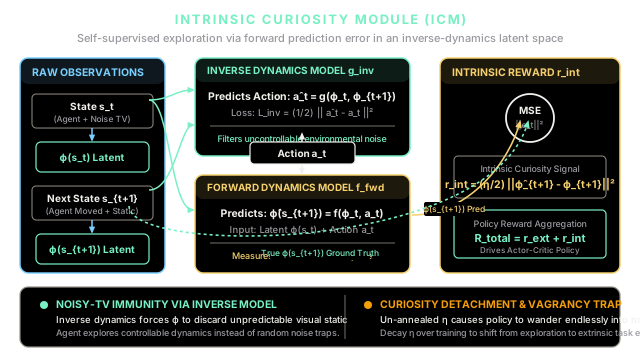
Curiosity-Driven Exploration rewards reinforcement learning agents for visiting states where forward dynamics are hard to predict, driving active environment discovery. By learning an inverse dynamics embedding space, the Intrinsic Curiosity Module filters out uncontrollable background noise to avoid getting trapped by random distractions.
Why Does This Exist?
In standard reinforcement learning, agents rely on extrinsic reward signals provided by the environment—such as scoring points in a game or crossing a finish line. In complex, sparse-reward environments (such as navigating a maze or solving a multi-stage robotic manipulation task), an extrinsic reward is only awarded after thousands of coordinated actions. An agent executing random actions (such as -greedy exploration) will virtually never stumble onto the goal, causing training to stall indefinitely.
To overcome sparse feedback, researchers introduced intrinsic motivation: rewarding the agent internally for curiosity and novelty. Early formulations generated intrinsic rewards based on prediction error in raw observation space: if an agent predicts the next pixel frame given state and action , the squared pixel error serves as a curiosity bonus.
However, raw prediction error suffers from a fatal flaw known as the Noisy TV Problem. If the environment contains irrelevant, uncontrollable stochasticity—such as leaves blowing in the wind, water ripples, or a television monitor playing random static noise—the forward dynamics of those pixels are fundamentally unpredictable. An agent rewarded for raw pixel prediction error will walk up to the television and stare at the static indefinitely, mesmerized by infinite, meaningless novelty while never exploring the actual task.
The Intrinsic Curiosity Module (ICM), formulated by Deepak Pathak et al. (2017), solves this problem by projecting raw states into a compact latent feature space learned via inverse dynamics. By forcing the latent features to predict the agent's chosen action, ICM strips away all uncontrollable visual distractors. The forward model then predicts transitions exclusively within this noise-immune feature space, generating intrinsic rewards that compel the agent to explore meaningful, agent-controllable environmental dynamics.
Think of It Like This
The Science Detective and the Uncontrollable Noise
Imagine a forensic science detective sent to investigate an unfamiliar, sprawling estate. If the detective investigated every single microscopic change in the environment, they would spend eight hours staring at leaves rustling randomly on an oak tree outside the window, fascinated by how unpredictable the leaf positions are from second to second.
A skilled human detective doesn't do that. Instead, the detective ignores the rustling leaves and TV static because they recognize: "Nothing I do changes how the leaves blow or how the static flickers."
The detective concentrates exclusively on clues that exhibit a cause-and-effect relationship with deliberate physical actions: doors that swing open when a handle is turned, levers that trigger hidden bookshelf latches, and safes that click when combinations are dialed.
The detective formulates mental hypotheses about what will happen next: "If I turn this brass key, the iron door should unlock." When the key turns and a secret passage swings open, the detective experiences a jolt of surprise and curiosity—an internal dopamine bonus—because their mental prediction was challenged by a new discovery. Once the detective tests the door three or four times and understands the mechanism completely, the surprise drops to zero, and they move on to explore the next unsolved room.
Where the analogy stops: A human detective possesses lifelong semantic priors about locks and doors, whereas ICM starts with zero knowledge and must learn which visual pixels represent cause-and-effect dynamics entirely from scratch using backpropagated neural gradients.
How It Actually Works
The Dual-Model Architecture and Noisy TV Resolution
Consider an agent interacting with an environment with state , taking action , and observing next state . The Intrinsic Curiosity Module decomposes exploration into two sub-networks: an Inverse Dynamics Model and a Forward Dynamics Model, mediated by a shared Feature Encoder .
Raw Observation s_t ────► [ Feature Encoder φ ] ────► φ(s_t) │ ┌──────────────────────────┴───────────────┐ ▼ ▼ Raw Observation s_{t+1} ──► [ Feature Encoder φ ] ──► φ(s_{t+1}) Action a_t │ │ ▼ ▼ [ Inverse Dynamics g_inv ] [ Forward Dynamics f_fwd ] │ │ ▼ ▼ Predicted â_t Predicted φ̂(s_{t+1}) │ │ ▼ ▼ Loss: L_inv(â_t, a_t) Error: e = φ̂ - φ(s_{t+1}) (Forces φ to ignore noise TV) │ ▼ Reward: r_int ∝ ||e||²1. Feature Encoder and the Inverse Dynamics Model
The feature encoder maps high-dimensional observations (e.g., raw video frames) into a compact latent vector .
The Inverse Dynamics Model takes the latent representations of two consecutive states and predicts the action that caused the transition:
For continuous actions, the inverse loss is the Mean Squared Error:
For discrete actions, is the multi-class categorical cross-entropy over action logits.
The Crucial Invariant: The parameters of the feature encoder are updated via gradient descent on . In order to predict the agent's action , is pressured to retain only those features that change as a result of the agent's actions or that directly influence the agent. Uncontrollable environmental patterns (flickering televisions, drifting background clouds, moving wallpaper) contain zero mutual information about . Consequently, gradients ruthlessly scrub uncontrollable noise from the latent embedding , rendering the representation immune to the Noisy TV Problem.
2. The Forward Dynamics Model and Intrinsic Reward
The Forward Dynamics Model predicts the future latent embedding conditioned on the current embedding and the executed action :
The forward loss measures how inaccurate the forward model's prediction is:
The Intrinsic Curiosity Reward supplied to the reinforcement learning policy is directly proportional to this prediction error:
where is a curiosity scaling hyperparameter.
3. Joint Optimization Objective
The reinforcement learning agent optimizes a policy to maximize the combined return , where is the extrinsic task reward. The overall system jointly minimizes three objectives:
where is a weighting hyperparameter (typically , placing greater weight on learning an accurate inverse embedding). Note that gradients from do not update the policy directly; instead, supplies the scalar reward used by the policy gradient algorithm (such as PPO or A2C).
Worked numerical example
Let us trace a single forward-inverse calculation through the Intrinsic Curiosity Module step-by-step with concrete numerical values.
Setup
Consider a 2-dimensional latent feature space () and a 1-dimensional continuous action ():
- Current latent state:
- True next latent state:
- Executed action:
- Curiosity scale:
- Model trade-off parameter:
The sub-networks produce the following forward and inverse predictions:
- Forward model prediction:
- Inverse model action prediction:
Step 1: Compute Forward Prediction Error Vector
Calculate the difference between the forward model's predicted next latent state and the ground-truth next latent state:
Step 2: Compute Squared Norm Error
Calculate the squared norm of the prediction error vector:
Step 3: Compute Intrinsic Curiosity Reward
Evaluate the scalar reward granted to the RL policy:
The agent receives an intrinsic reward of for taking action in state , encouraging the policy to repeat actions leading to unfamiliar transition dynamics.
Step 4: Evaluate Inverse Dynamics Loss
Compute the Mean Squared Error between the predicted action and true action :
Step 5: Evaluate Forward Dynamics Loss
Compute the forward MSE loss:
Step 6: Compute Composite ICM Optimization Loss
Combine the forward and inverse losses using :
The total composite loss for the curiosity module is . Backpropagating this loss updates the forward model parameters , the inverse model parameters , and the shared encoder parameters .
Code
The following self-contained Python script implements the Intrinsic Curiosity Module, computes forward and inverse dynamics errors, generates intrinsic curiosity rewards, filters uncontrollable visual noise, and validates the numerical example step-by-step.
from typing import Dict, Tupleimport numpy as np
class IntrinsicCuriosityModule: """Intrinsic Curiosity Module (ICM) based on Pathak et al. (ICML 2017).
Overcomes the Noisy TV problem by learning an inverse dynamics embedding space that filters uncontrollable environmental noise before evaluating forward dynamics prediction error. """
def __init__( self, obs_dim: int, feature_dim: int, action_dim: int, eta: float = 1.0, beta: float = 0.2, ) -> None: self.obs_dim = obs_dim self.feature_dim = feature_dim self.action_dim = action_dim self.eta = eta self.beta = beta
def compute_intrinsic_reward( self, phi_next: np.ndarray, hat_phi_next: np.ndarray, ) -> Tuple[float, np.ndarray]: """Calculates curiosity reward: r_int = (eta / 2) * ||hat_phi(s_{t+1}) - phi(s_{t+1})||_2^2.""" error_vec = hat_phi_next - phi_next sq_norm = float(np.sum(error_vec ** 2)) r_int = (self.eta / 2.0) * sq_norm return r_int, error_vec
def compute_losses( self, action: np.ndarray, hat_action: np.ndarray, phi_next: np.ndarray, hat_phi_next: np.ndarray, ) -> Dict[str, float]: """Calculates inverse, forward, and total composite ICM losses.""" # Inverse loss: MSE on predicted action L_inv = 0.5 * ||hat_a_t - a_t||^2 inv_loss = 0.5 * float(np.sum((hat_action - action) ** 2))
# Forward loss: MSE on predicted latent embedding L_fwd = 0.5 * ||hat_phi - phi||^2 fwd_loss = 0.5 * float(np.sum((hat_phi_next - phi_next) ** 2))
# Combined ICM objective: beta * L_fwd + (1 - beta) * L_inv total_loss = self.beta * fwd_loss + (1.0 - self.beta) * inv_loss
return { "loss_inv": inv_loss, "loss_fwd": fwd_loss, "loss_icm": total_loss, }
# --- Step-by-Step Numerical Example Verification ---icm = IntrinsicCuriosityModule(obs_dim=4, feature_dim=2, action_dim=1, eta=1.0, beta=0.2)
# True latent states and actual action executedphi_t = np.array([0.50, 0.20], dtype=np.float64)phi_next = np.array([0.80, 0.40], dtype=np.float64)action = np.array([1.00], dtype=np.float64)
# Network predictions from forward and inverse modelshat_phi_next = np.array([0.60, 0.30], dtype=np.float64)hat_action = np.array([0.90], dtype=np.float64)
# 1. Compute intrinsic reward and prediction error vectorr_int, err_vec = icm.compute_intrinsic_reward(phi_next, hat_phi_next)
# 2. Compute composite training losseslosses = icm.compute_losses(action, hat_action, phi_next, hat_phi_next)
print(f"Prediction Error Vector e: [{err_vec[0]:.2f}, {err_vec[1]:.2f}]")# -> Prediction Error Vector e: [-0.20, -0.10]
squared_norm = float(np.sum(err_vec ** 2))print(f"Squared L2 Norm ||e||^2: {squared_norm:.4f}")# -> Squared L2 Norm ||e||^2: 0.0500
print(f"Intrinsic Curiosity Reward r_int: {r_int:.4f}")# -> Intrinsic Curiosity Reward r_int: 0.0250
print(f"Inverse Dynamics Loss L_inv: {losses['loss_inv']:.4f}")# -> Inverse Dynamics Loss L_inv: 0.0050
print(f"Forward Dynamics Loss L_fwd: {losses['loss_fwd']:.4f}")# -> Forward Dynamics Loss L_fwd: 0.0250
print(f"Total ICM Composite Loss L_ICM: {losses['loss_icm']:.4f}")# -> Total ICM Composite Loss L_ICM: 0.0090
# Assertions matching worked examplenp.testing.assert_allclose(err_vec, [-0.20, -0.10], atol=1e-5)np.testing.assert_allclose(squared_norm, 0.0500, atol=1e-5)np.testing.assert_allclose(r_int, 0.0250, atol=1e-5)np.testing.assert_allclose(losses["loss_inv"], 0.0050, atol=1e-5)np.testing.assert_allclose(losses["loss_fwd"], 0.0250, atol=1e-5)np.testing.assert_allclose(losses["loss_icm"], 0.0090, atol=1e-5)print("ICM numerical assertions passed successfully.")# -> ICM numerical assertions passed successfully.Watch Out For
Curiosity Hijacking and the Vagrancy Trap: Late-Training Detachment
While intrinsic curiosity is crucial for exploring sparse environments during initial iterations, keeping the curiosity scaling hyperparameter static and un-annealed throughout late training causes severe failure modes.
Symptom: The agent exhibits "curiosity detachment" or perpetual vagrancy. Even after discovering the goal and receiving sparse extrinsic rewards, the policy continues wandering into unfamiliar, high-variance peripheral corridors because the forward model has not yet memorized every obscure wall corner. The agent fails to exploit the solved path, leading to unstable policy evaluation and plateaued extrinsic task performance.
Concrete Fix:
- Curiosity Annealing: Systematically anneal towards zero over training steps (e.g., exponential or linear decay ), smoothly transitioning the agent from curiosity-driven discovery to extrinsic goal exploitation.
- Intrinsic Reward Normalization: Normalize by dividing by a running standard deviation of intrinsic returns, preventing early forward model gradient spikes from destabilizing the policy network value baseline.
- Episodic Novelty Decay: Couple ICM with episodic novelty counters that discount intrinsic rewards for repeated states encountered within the same episode.
The Quick Version
- Solves Sparse-Reward Exploration: ICM generates intrinsic exploration rewards proportional to forward dynamics prediction error, allowing agents to solve complex sparse-reward environments without extrinsic guidance.
- Immune to the Noisy TV Problem: By embedding raw visual states through an inverse dynamics model trained to predict the agent's action, ICM filters out uncontrollable background noise and random distractions.
- Dual-Branch Architecture: An inverse model predicts action from , while a forward model predicts next embedding from .
- Self-Disappearing Reward: As the agent visits an environment repeatedly, the forward model masters its dynamics, driving prediction error and intrinsic rewards down to zero and naturally shifting policy focus to extrinsic goals.