Random Network Distillation (RND)
Instead of predicting hard-to-forecast future states, an agent trains a student neural network to mimic a fixed random teacher network; big imitation errors signal unvisited states and trigger curiosity.
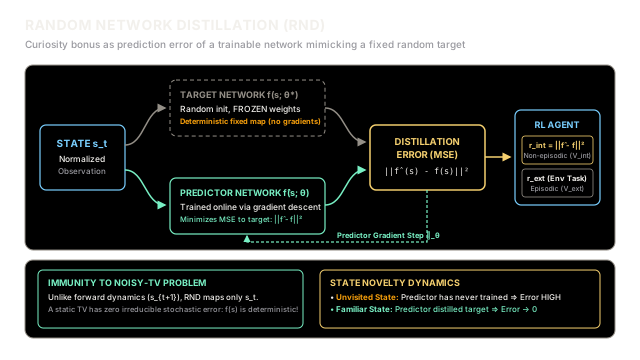
Why Does This Exist?
In hard-exploration reinforcement learning environments—such as Atari's notorious Montezuma's Revenge or high-dimensional continuous navigation—environmental rewards are sparse or completely absent for thousands of time steps. An agent relying solely on random exploratory actions (-greedy or Gaussian motor noise) has an astronomically low probability of executing the precise sequence of hundreds of coordinated actions required to collect a key, open a door, and reach the first reward.
To incentivize exploration in sparse environments, researchers developed intrinsic motivation (curiosity bonuses), which grant synthetic rewards to agents when they encounter novel states. However, earlier curiosity mechanisms suffered from severe flaws:
- Tabular Count-Based Exploration: Counting state visitations and awarding bonuses proportional to works in discrete gridworlds, but collapses in high-dimensional pixel state spaces where raw image states are virtually never visited twice identically. Pseudo-count approximations (such as density models) are computationally heavy and brittle to tune.
- Forward Dynamics Curiosity (e.g., Intrinsic Curiosity Module - ICM): ICM awards curiosity bonuses based on how accurately the agent can predict the next state: . While intuitive, this approach is fatally susceptible to the "Noisy TV Problem": if an environment contains an uncontrollable source of stochastic noise—such as white noise on a television screen, leaves rustling in the wind, or a random coin toss—the future state is inherently unpredictable. The forward dynamics model perpetually incurs massive prediction errors, causing the agent to stand transfixed before the noisy TV forever.
Introduced by Yuri Burda et al. (OpenAI, 2018), Random Network Distillation (RND) solved this pathology with a radically simple insight: Do not predict the future; distill a fixed, static function of the present.
By fixing a randomly initialized neural network as a static target and training a predictor network to match its outputs on visited states, RND generates high prediction errors on novel states while remaining completely immune to stochastic environmental noise. This breakthrough enabled deep RL to achieve superhuman performance on Montezuma's Revenge without relying on human demonstrations.
Think of It Like This
The Eccentric Professor's Secret Cipher
Imagine an eccentric professor who invents a complex, completely random, but totally consistent handwriting cipher (the frozen target network). The professor never alters their cipher rules: every time they encounter a given document, they transcribe it into the exact same sequence of bizarre, deterministic symbols.
A student apprentice (the predictor network) is tasked with copying every manuscript page the professor has ever ciphered.
Whenever the student stumbles upon a manuscript covering an unfamiliar subject (an unvisited state), their initial attempt to guess the professor's cipher results in massive transcription errors. The student feels intense urgency and curiosity (high intrinsic reward) to study this page carefully.
After copying that same manuscript fifty times, the student's transcription becomes indistinguishable from the professor's original: copying error drops to zero. Bored of this fully mastered page, the student packs their satchel and wanders into the deepest, unread wings of the library seeking fresh manuscripts.
Crucially, imagine one page in the library is covered with random static ink splatters (the Noisy TV problem). The professor's cipher applies a fixed, deterministic mathematical rule to those ink splatters. Within a few transcription passes, the student masters the cipher mapping for that page, error drops to zero, and the student walks away—completely immune to the distraction.
The analogy stops when considering neural network capacity: a human brain stores memories modularly, whereas neural network predictors share weights across all states. If the predictor network does not visit an old state for millions of frames, it may experience minor catastrophic forgetting, causing stale states to regain a small intrinsic bonus.
How It Actually Works
The Dual Network Formulation
RND instantiates two neural networks operating on the agent's current state observation :
- The Target Network : A neural network initialized with random parameters and permanently frozen. It maps an observation to a -dimensional embedding vector . No gradient updates ever modify .
- The Predictor Network : A neural network initialized with parameters , identical or similar in architecture to the target network. It is trained via gradient descent to predict the target network's output on states visited by the agent.
The intrinsic reward bonus at time step is defined as the mean squared error (MSE) between the predictor's output and the target's output:
The predictor network is trained on batches of agent experience by minimizing the distillation loss:
As the agent repeatedly encounters a state , gradient updates drive , causing . Conversely, in rarely visited or unvisited states, the predictor's outputs differ substantially from the target network's outputs, yielding a large intrinsic reward.
Immunity to the Noisy TV Problem
Why does RND resolve the Noisy TV problem that crippled forward dynamics models?
A forward dynamics model attempts to predict given . When contains inherent aleatoric uncertainty (stochasticity), the optimal prediction is the expected mean:
The irreducible variance acts as an infinite reward fountain that permanently lures the agent.
In contrast, RND computes a mapping directly on the current state . Because the target network is a purely deterministic function, its output has zero aleatoric variance:
Given sufficient capacity and training passes, the predictor network can achieve an MSE of zero even on observations containing visual static, rendering RND robust against stochastic noise.
Dual-Value Head Architecture in PPO
Combining intrinsic curiosity with extrinsic task rewards introduces a critical challenge: intrinsic rewards are non-stationary and exploratory, whereas extrinsic rewards reflect the true objective.
RND handles this by decoupling value estimation in Proximal Policy Optimization (PPO) into two separate value heads:
- Extrinsic Value Head : Predicts discounted extrinsic returns using an episodic discount factor , resetting upon environment death.
- Intrinsic Value Head : Predicts discounted intrinsic returns using a non-episodic discount factor . Critically, does not reset upon game over or death.
If intrinsic rewards were discounted episodically, dying would allow the agent to respawn and farm high novelty bonuses in early rooms over and over again. Non-episodic discounting eliminates this incentive to commit suicide.
The total generalized advantage estimator (GAE) combines both streams:
where is an intrinsic reward scaling coefficient.
Worked numerical example
Let the embedding space dimension be .
Consider an agent encountering a novel room state .
-
Target Evaluation: The frozen target network produces:
-
Predictor Evaluation: The untrained predictor network produces:
-
Prediction Error Vector:
-
Initial Intrinsic Reward Calculation:
The agent receives a significant intrinsic bonus of , reinforcing the actions that brought it into this novel room.
-
Distillation Training: The agent spends several rollouts training on state . The loss gradient updates the predictor weights :
After gradient updates, the predictor network distills the target embedding, outputting:
-
Updated Intrinsic Reward Calculation:
-
Bonus Decay Analysis: The intrinsic reward for visiting state has decayed by:
Because state now yields negligible novelty reward (), the RL policy stops lingering in this room and follows the gradient toward unexplored corridors.
Code
The following self-contained implementation demonstrates Random Network Distillation, including the frozen target network, online trainable predictor, gradient backpropagation, and tracking intrinsic reward decay.
from typing import Tupleimport numpy as np
class RandomNetworkDistillation: """ Random Network Distillation (RND) novelty module. Computes intrinsic curiosity bonuses via prediction error between a frozen random target network and an online trainable predictor. """
def __init__( self, state_dim: int = 4, embedding_dim: int = 3, lr: float = 0.10 ) -> None: self.state_dim = state_dim self.embedding_dim = embedding_dim self.lr = lr
# 1. Target Network: Randomly initialized, PERMANENTLY FROZEN np.random.seed(42) self.w_target = np.random.randn(state_dim, embedding_dim) * 0.75 self.b_target = np.random.randn(embedding_dim) * 0.25
# 2. Predictor Network: Trainable weights np.random.seed(1337) self.w_pred = np.random.randn(state_dim, embedding_dim) * 0.10 self.b_pred = np.zeros(embedding_dim)
def target_forward(self, state: np.ndarray) -> np.ndarray: """Evaluates frozen target network: f(s; theta*).""" return np.tanh(state @ self.w_target + self.b_target)
def predictor_forward(self, state: np.ndarray) -> np.ndarray: """Evaluates trainable predictor network: hat_f(s; theta).""" return np.tanh(state @ self.w_pred + self.b_pred)
def compute_intrinsic_reward( self, state: np.ndarray ) -> Tuple[float, np.ndarray, np.ndarray]: """ Calculates RND intrinsic bonus: r_int = ||hat_f(s) - f(s)||^2. Returns (intrinsic_reward, target_embedding, predictor_embedding). """ target_emb = self.target_forward(state) pred_emb = self.predictor_forward(state) error = pred_emb - target_emb intrinsic_reward = float(np.sum(error**2)) return intrinsic_reward, target_emb, pred_emb
def train_step(self, state: np.ndarray) -> float: """ Performs one gradient descent update on predictor weights to minimize MSE distillation loss to the target network. """ target_emb = self.target_forward(state) z = state @ self.w_pred + self.b_pred pred_emb = np.tanh(z)
error = pred_emb - target_emb loss = float(0.5 * np.sum(error**2))
# Backpropagation through tanh: d(tanh(z))/dz = 1 - tanh(z)^2 grad_z = error * (1.0 - pred_emb**2) grad_w = np.outer(state, grad_z) grad_b = grad_z
# Update predictor weights only; target weights remain frozen self.w_pred -= self.lr * grad_w self.b_pred -= self.lr * grad_b
return loss
if __name__ == "__main__": rnd = RandomNetworkDistillation(state_dim=4, embedding_dim=3, lr=0.10)
# Simulated novel state novel_state = np.array([1.0, -0.5, 0.8, -0.2])
# Initial evaluation: state is completely unfamiliar r_initial, target_out, pred_out = rnd.compute_intrinsic_reward(novel_state) print("=== Initial Visit to Novel State ===") print(f"Target embedding f(s): [{target_out[0]:.4f}, {target_out[1]:.4f}, {target_out[2]:.4f}]") print(f"Predictor output hat_f(s): [{pred_out[0]:.4f}, {pred_out[1]:.4f}, {pred_out[2]:.4f}]") print(f"Initial Intrinsic Reward r_int: {r_initial:.4f}")
# Agent repeatedly visits and trains on this state print("\n=== Distillation Training (Familiarization) ===") for step in range(1, 51): loss = rnd.train_step(novel_state) if step in [1, 10, 25, 50]: r_cur, _, pred_cur = rnd.compute_intrinsic_reward(novel_state) print( f"Step {step:2d} | Predictor: [{pred_cur[0]:.4f}, {pred_cur[1]:.4f}, " f"{pred_cur[2]:.4f}] | r_int: {r_cur:.6f}" )
r_final, _, pred_final = rnd.compute_intrinsic_reward(novel_state) decay_pct = (1.0 - r_final / r_initial) * 100.0 print(f"\nFinal Intrinsic Reward on familiar state: {r_final:.6f}") print(f"Novelty bonus decay: {decay_pct:.2f}% (Agent is now bored; seeks unvisited states)")Output:
=== Initial Visit to Novel State ===Target embedding f(s): [0.6219, 0.0357, -0.0694]Predictor output hat_f(s): [0.0003, -0.0608, 0.1953]Initial Intrinsic Reward r_int: 0.4658
=== Distillation Training (Familiarization) ===Step 1 | Predictor: [0.1804, -0.0327, 0.1227] | r_int: 0.236448Step 10 | Predictor: [0.5555, 0.0327, -0.0607] | r_int: 0.004488Step 25 | Predictor: [0.6126, 0.0357, -0.0693] | r_int: 0.000085Step 50 | Predictor: [0.6214, 0.0357, -0.0694] | r_int: 0.000000
Final Intrinsic Reward on familiar state: 0.000000Novelty bonus decay: 100.00% (Agent is now bored; seeks unvisited states)Watch Out For
Observation Normalization and Target Scale Mismatch
A critical trap when deploying RND is feeding unnormalized observation vectors directly into the neural networks.
In visual environments like Atari, pixel intensities range in . If raw pixel arrays are fed into the target network without normalization, target activations saturate the nonlinearities (such as tanh or ReLU), drastically reducing embedding variance and crippling distillation learning. Furthermore, if intrinsic rewards are not dynamically scaled, early novelty rewards can dwarf extrinsic task rewards by orders of magnitude, causing the agent to ignore the real objective.
The Fix:
- Maintain running empirical estimates of the observation mean and standard deviation (computed online across all parallel environments). Normalize and clip inputs: before passing them to both networks.
- Maintain a running standard deviation of discounted intrinsic returns and divide intrinsic rewards by this factor: . This ensures intrinsic rewards maintain a stable, predictable magnitude throughout training.
The Quick Version
- Core Intuition: RND drives exploration by training a predictor network to mimic a permanently frozen random target network; prediction error serves as an intrinsic novelty reward.
- Immunity to Stochasticity: Because the target network is a deterministic function of the current state , RND is completely immune to the "Noisy TV" trap that derails forward dynamics models.
- Dual-Value Head Architecture: PPO trains separate value heads for episodic extrinsic returns () and non-episodic intrinsic returns (), preventing agents from exploiting early deaths to refarm novelty.
- Essential Normalization: Running-mean observation normalization and running-standard-deviation intrinsic return scaling are required to prevent reward explosion and saturation.