Exploration and Intrinsic Motivation
When external task rewards are rare or nonexistent, intrinsic motivation supplements the environment with self-generated curiosity bonuses that compel an agent to systematically explore uncharted territory.
Why Does This Exist?
In classic reinforcement learning benchmarks (such as CartPole or pendulum swing-up), the environment provides dense scalar rewards at every single step. In such settings, simple undirected exploration—such as -greedy random action flips or Gaussian motor perturbation —suffices to discover good trajectories.
However, real-world tasks and hard challenge benchmarks (such as Montezuma's Revenge, long-horizon robotic manipulation, or complex maze navigation) feature extremely sparse rewards. An agent might need to execute thousands of coordinated actions (climbing down ladders, dodging skull hazards, collecting keys, unlocking doors) before receiving a single non-zero extrinsic reward.
Under undirected exploration, the probability of stumbling upon a goal trajectory of length by random chance decays exponentially:
When and , this probability is roughly . Consequently:
- Zero Temporal Difference Signals: Every state yields . The temporal difference error remains identically zero everywhere.
- Gradient Starvation: Policy gradient algorithms receive zero variance in return, causing policy gradients to vanish.
- Diffusion Traps: The agent behaves like a random particle undergoing Brownian motion, wandering aimlessly around the starting state and repeatedly revisiting the same familiar locations without making forward progress.
Intrinsic motivation overcomes this fundamental bottleneck by equipping the agent with an internal, self-generated reward engine. Inspired by developmental psychology and early formulations by Schmidhuber (1991) and Oudeyer & Kaplan (2007), intrinsic reinforcement learning constructs an augmented reward function that pays the agent bonuses for visiting unfamiliar states, experiencing prediction surprise, or gaining information about the environment.
Think of It Like This
The Explorer Mapping Uncharted Caverns
Imagine a speleologist exploring a massive, pitch-black subterranean cavern system spanning dozens of miles:
- The Extrinsic Reward (): A legendary chest of gold coins hidden in the deepest, most remote chamber 10 miles underground. The cavern contains no map, no trail markers, and no intermediate prizes.
- The Undirected Explorer (-greedy): Blindfolded, this explorer takes random steps forward, backward, left, and right. Within five minutes, they bump into the same cavern entrance walls hundreds of times, making zero progress toward the 10-mile goal before running out of supplies.
- The Intrinsically Motivated Explorer (): This explorer carries a blank notebook and an innate sense of curiosity:
- Whenever they enter a chamber they have never seen before, their brain releases a surge of satisfaction (Novelty Bonus).
- Whenever a side tunnel echoes in an unexpected direction that violates their mental layout, they are compelled to walk down it to see what causes the echo (Prediction Error Bonus).
- Every time they visit a chamber, they draw it in their notebook. As a chamber becomes thoroughly mapped and familiar, its curiosity value drops to zero (Novelty Decay).
Driven purely by the desire to fill in the blank pages of their map, the explorer methodically advances through the entire cavern system. Even though they had no idea where the gold chest was located, their systematic exploration naturally leads them straight to the deepest chamber where the gold resides.
Where the analogy stops: Human explorers possess intuitive physical commonsense (they know water flows downhill, cliffs cause falls, and walls cannot be walked through). A reinforcement learning agent begins tabula rasa—it must learn physical dynamics and novelty entirely from scratch while resisting distracting stochastic noise.
How It Actually Works
The Composite Reward Formulation
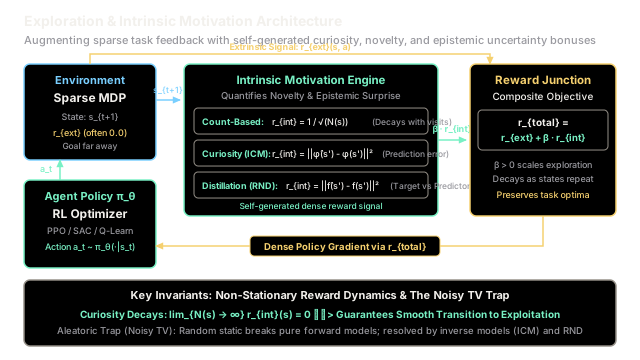
Intrinsic reinforcement learning augments the sparse extrinsic environment reward with a self-generated intrinsic reward , weighted by an exploration hyperparameter :
The agent's objective is to maximize the expected cumulative discounted composite return:
In modern actor-critic implementations (such as RND or Never Give Up), agents often maintain two separate value heads:
- An extrinsic value critic discounted by (e.g., ) tracking long-horizon task completion.
- An intrinsic value critic discounted by (e.g., ) tracking immediate local exploration.
┌─────────────────────────────────────────┐ │ Environment Transition (s_t, a_t, s_{t+1})│ └────────────────────┬────────────────────┘ │ ┌──────────────────────┴──────────────────────┐ ▼ ▼┌───────────────────────────────┐ ┌───────────────────────────────┐│ Extrinsic Task Reward │ │ Intrinsic Motivation Engine ││ r_ext (sparse, task-aligned) │ │ Quantifies Epistemic Novelty │└───────────────┬───────────────┘ └───────────────┬───────────────┘ │ │ │ ▼ │ Intrinsic Bonus β · r_int │ │ └──────────────────────┬──────────────────────┘ ▼ ┌───────────────────────────┐ │ Composite Reward Junction │ │ r_total = r_ext + β·r_int│ └─────────────┬─────────────┘ │ ▼ ┌───────────────────────────┐ │ Policy & Critic Optimizer │ │ (PPO / SAC / Q-Learning) │ └───────────────────────────┘The Taxonomy of Intrinsic Motivation
How should an agent mathematically quantify novelty and surprise? Modern RL categorizes intrinsic exploration into five dominant paradigms:
1. Count-Based Novelty
In tabular settings, the classic Upper Confidence Bound (UCB) and count-based exploration bonuses reward states inversely proportional to the square root of their historical visit count:
In continuous, high-dimensional spaces where exact state visitation counts are always or , algorithms like CTS Density Models (Bellemare et al., 2016) and Hash-based Exploration compute continuous pseudo-counts derived from generative density estimates .
2. Forward Dynamics Prediction Error (ICM)
Pathak et al. (2017) formalized curiosity via the Intrinsic Curiosity Module (ICM). A neural forward dynamics model predicts the next state feature representation given current features and action :
If the agent transitions into an unfamiliar state whose transition dynamics it has not mastered, the prediction error is large, generating a strong curiosity incentive.
3. Bayesian Information Gain
Drawing from active learning, information gain rewards the reduction in model uncertainty (entropy) over model parameters after observing transition :
This directly measures how much the agent's internal hypothesis about the world changes as a result of that specific step.
4. Random Network Distillation (RND)
Burda et al. (2018) introduced Random Network Distillation (RND) to eliminate the need for training forward dynamics models. A fixed, randomly initialized neural target network maps states to a random embedding. An online predictor network is trained via gradient descent to match :
On familiar states, the predictor fits the target and error drops to zero. On novel states, the predictor generalizes poorly, emitting a clean novelty bonus.
5. Empowerment and Mutual Information
Empowerment measures an agent's operational control over future states, quantified as the channel capacity (mutual information) between a sequence of actions and future states :
Agents motivated by empowerment actively seek out states where they possess maximal behavioral influence over their surroundings.
Non-Stationarity and the Exploration-to-Exploitation Transition
A critical mathematical property of intrinsic rewards is their non-stationarity. Unlike extrinsic rewards which are fixed properties of the environment MDP, depends on the agent's historical experience:
As an agent thoroughly maps out an environment:
- State novelty and prediction errors decay toward zero.
- The composite reward converges to the true extrinsic reward: .
- The policy naturally transitions from broad exploratory roaming to optimal exploitation of discovered task goals.
Worked numerical example
Let us trace step-by-step arithmetic on a sparse Chain MDP to observe how intrinsic novelty creates a directional exploration gradient where standard Q-learning stalls.
Step 1: Environment and Setup
Consider a 6-state chain: .
- Goal state: , which yields extrinsic reward and terminates the episode.
- All intermediate transitions yield .
- Actions: (Left/Stay), (Right).
- Learning rate , discount factor , intrinsic scaling .
- Count-based novelty bonus: .
Step 2: Monotonic Decay of Intrinsic Bonus
Suppose the agent steps from across multiple episodes.
- First Visit ():
- Fourth Visit ():
- Ninth Visit ():
Notice that curiosity diminishes monotonically as familiarity increases ().
Step 3: TD Q-Value Update under Novelty
On the very first visit (), all initial Q-values are . The agent executes action (Right) from to arrive at :
Whereas standard Q-learning with leaves (leaving the agent deadlocked at ), the intrinsic bonus boosts to . When placed back at , the agent deterministically chooses action (Right) over action (Left), systematically marching deeper into the chain toward the goal!
Code
Below is a self-contained, typed Python implementation demonstrating how count-based intrinsic rewards guide an agent across a sparse chain MDP where standard reinforcement learning stalls.
import mathfrom typing import Dict, List, Tuple
class SparseChainEnvironment: """A sparse 6-state Chain MDP: s0 <-> s1 <-> s2 <-> s3 <-> s4 <-> s5 (Goal).
Actions: 0 = Left/Stay, 1 = Right. Extrinsic reward: +10.0 ONLY upon reaching state s5 (terminal). All intermediate transitions yield 0.0 extrinsic reward. """
def __init__(self, chain_length: int = 6, max_steps: int = 20) -> None: self.chain_length = chain_length self.goal_state = chain_length - 1 self.max_steps = max_steps self.state = 0 self.step_count = 0
def reset(self) -> int: self.state = 0 self.step_count = 0 return self.state
def step(self, action: int) -> Tuple[int, float, bool]: self.step_count += 1 if action == 1: self.state = min(self.goal_state, self.state + 1) else: self.state = max(0, self.state - 1)
done = self.state == self.goal_state or self.step_count >= self.max_steps r_ext = 10.0 if self.state == self.goal_state else 0.0 return self.state, r_ext, done
class IntrinsicExplorationFramework: """Demonstrates how count-based intrinsic novelty overcomes the sparse-reward exploration bottleneck.
Under pure greedy action selection: - Standard RL has 0.0 reward everywhere and gets stuck in local loops (0 goals discovered). - Intrinsic RL creates an internal curiosity gradient, pulling the agent across the chain to the goal. """
def __init__( self, chain_length: int = 6, gamma: float = 0.90, alpha: float = 0.50, beta: float = 0.50, ) -> None: self.chain_length = chain_length self.gamma = gamma self.alpha = alpha self.beta = beta
def compute_intrinsic_reward(self, visit_count: int) -> float: """Count-based novelty bonus: r_int = 1 / sqrt(N(s')).""" if visit_count <= 0: return 1.0 return 1.0 / math.sqrt(visit_count)
def run_simulation( self, use_intrinsic: bool, max_episodes: int = 20 ) -> Tuple[int, int]: """Runs tabular Q-learning with tie-breaking defaulting to Action 0 (Left/Stay).""" env = SparseChainEnvironment(self.chain_length, max_steps=20) q_table: Dict[Tuple[int, int], float] = { (s, a): 0.0 for s in range(self.chain_length) for a in [0, 1] } visit_counts: Dict[int, int] = {s: 0 for s in range(self.chain_length)}
episodes_to_first_goal = -1 total_goals_discovered = 0
for ep in range(1, max_episodes + 1): s = env.reset() visit_counts[s] += 1 done = False
while not done: # Deterministic action selection: pick action with strictly highest Q-value. if q_table[(s, 1)] > q_table[(s, 0)]: a = 1 elif q_table[(s, 0)] > q_table[(s, 1)]: a = 0 else: # In standard RL with 0 reward, unvisited states default to staying at s0. # With intrinsic bonuses, unvisited neighbors yield positive exploration targets. a = 1 if use_intrinsic else 0
next_s, r_ext, done = env.step(a) visit_counts[next_s] += 1
if use_intrinsic: r_int = self.compute_intrinsic_reward(visit_counts[next_s]) r_tot = r_ext + self.beta * r_int else: r_tot = r_ext
next_max_q = ( 0.0 if next_s == env.goal_state else max(q_table[(next_s, 0)], q_table[(next_s, 1)]) )
# TD Q-value update td_target = r_tot + self.gamma * next_max_q td_error = td_target - q_table[(s, a)] q_table[(s, a)] += self.alpha * td_error
s = next_s
if env.state == env.goal_state: total_goals_discovered += 1 if episodes_to_first_goal == -1: episodes_to_first_goal = ep
return episodes_to_first_goal, total_goals_discovered
if __name__ == "__main__": framework = IntrinsicExplorationFramework( chain_length=6, gamma=0.90, alpha=0.50, beta=0.50 )
# 1. Exact step-by-step arithmetic check # State s0 -> s1 on visits 1, 4, 9 r_int_1 = framework.compute_intrinsic_reward(1) r_tot_1 = 0.0 + framework.beta * r_int_1 assert math.isclose(r_int_1, 1.0000) assert math.isclose(r_tot_1, 0.5000)
r_int_4 = framework.compute_intrinsic_reward(4) r_tot_4 = 0.0 + framework.beta * r_int_4 assert math.isclose(r_int_4, 0.5000) assert math.isclose(r_tot_4, 0.2500)
r_int_9 = framework.compute_intrinsic_reward(9) r_tot_9 = 0.0 + framework.beta * r_int_9 assert math.isclose(r_int_9, 1.0 / 3.0, rel_tol=1e-4) assert math.isclose(r_tot_9, 0.50 / 3.0, rel_tol=1e-4)
# TD update arithmetic q_s0_init = 0.0 td_target = r_tot_1 + 0.90 * 0.0 q_s0_updated = q_s0_init + 0.50 * (td_target - q_s0_init) assert math.isclose(q_s0_updated, 0.2500)
print("=== Count-Based Intrinsic Decay Verification ===") print(f"Visit N=1: r_int = {r_int_1:.4f}, r_tot = {r_tot_1:.4f}, TD Q-update = {q_s0_updated:.4f}") print(f"Visit N=4: r_int = {r_int_4:.4f}, r_tot = {r_tot_4:.4f}") print(f"Visit N=9: r_int = {r_int_9:.4f}, r_tot = {r_tot_9:.4f}")
# 2. Simulation comparison on Sparse Chain MDP ep_standard, goals_standard = framework.run_simulation( use_intrinsic=False, max_episodes=20 ) ep_intrinsic, goals_intrinsic = framework.run_simulation( use_intrinsic=True, max_episodes=20 )
print("\n=== Exploration Performance on 6-State Sparse Chain (20 Episodes) ===") print(f"Standard Q-Learning: First Goal: {ep_standard} (Failed), Total Goals: {goals_standard}/20") print(f"Intrinsic-Bonus Q-Learn: First Goal: Episode {ep_intrinsic}, Total Goals: {goals_intrinsic}/20")
assert ep_standard == -1 assert goals_standard == 0 assert ep_intrinsic == 1 assert goals_intrinsic == 20
print("\nAll Intrinsic Motivation simulation tests passed successfully!")Expected output:
=== Count-Based Intrinsic Decay Verification ===Visit N=1: r_int = 1.0000, r_tot = 0.5000, TD Q-update = 0.2500Visit N=4: r_int = 0.5000, r_tot = 0.2500Visit N=9: r_int = 0.3333, r_tot = 0.1667
=== Exploration Performance on 6-State Sparse Chain (20 Episodes) ===Standard Q-Learning: First Goal: -1 (Failed), Total Goals: 0/20Intrinsic-Bonus Q-Learn: First Goal: Episode 1, Total Goals: 20/20
All Intrinsic Motivation simulation tests passed successfully!Watch Out For
The Noisy TV Problem and Aleatoric Traps
The Trap: When an agent's curiosity is defined purely as forward dynamics prediction error , it is vulnerable to irreducible aleatoric noise (environmental randomness that cannot be predicted, such as white static on an old television, rustling tree leaves, or rolled dice). Because white noise is stochastic by nature, a deterministic forward model can never predict the next pixel configuration. The prediction error never decays to zero, no matter how many times the agent observes it.
The Symptom: The agent halts all meaningful exploration in the environment and parks itself directly in front of the "Noisy TV," hypnotized by the endless stream of maximum prediction error bonuses.
The Fix:
- Inverse Dynamics Feature Space (ICM): Project states through an encoder trained to predict the action taken between transitions . Because background static cannot be controlled or influenced by the agent's motor actions, the encoder filters out all stochastic environmental noise.
- Random Network Distillation (RND): Instead of predicting stochastic future frames , train a network to distill a static, deterministic function . Because the target function is deterministic, its distillation error is guaranteed to converge to zero upon repeated visitation, making it immune to white static.
The Quick Version
- Overcomes Sparse-Reward Deadlocks: When environment task rewards are sparse or zero, intrinsic motivation generates dense internal bonuses that guide systematic state discovery.
- Epistemic vs Aleatoric Uncertainty: Effective intrinsic curiosity rewards reducible epistemic uncertainty (states the agent has not yet learned) rather than irreducible aleatoric randomness (uncontrollable environmental noise).
- Composite Reward Function: Formulated as , where balances exploratory curiosity against task reward exploitation.
- Self-Regulating Convergence: As uncharted states become familiar, intrinsic rewards decay to zero (), naturally transitioning the agent from exploratory mapping to optimal task execution.