Generative Adversarial Imitation Learning (GAIL)
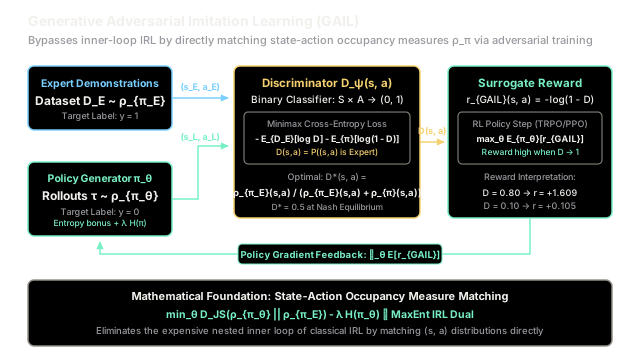
Instead of painstakingly reverse-engineering a hidden reward function, GAIL trains an agent to mirror expert demonstrations by pitting a policy generator against an adversarial discriminator.
Why Does This Exist?
When training autonomous agents in complex domains (such as robotic manipulation or autonomous driving), engineering a manual reward function that accurately captures desired behavior without unintended exploits is notoriously difficult. Imitation learning seeks to bypass manual reward engineering by learning directly from expert demonstrations .
However, historical imitation learning approaches suffered from two major limitations:
- Behavioral Cloning (BC) and Covariate Shift: BC treats imitation as supervised learning, mapping states to expert actions (). Because the supervisor never demonstrates how to recover from mistakes, minor execution errors compound quadratically over time ( distribution shift), causing catastrophic drift when the agent encounters unfamiliar states.
- The Inverse Reinforcement Learning (IRL) Computational Bottleneck: To overcome covariate shift, classical IRL algorithms (such as Maximum Entropy IRL and Apprenticeship Learning) hypothesize a reward function , solve a full reinforcement learning problem to convergence in an inner loop, compare the resulting policy's feature counts to the expert's, and update . In continuous, high-dimensional state-action spaces, repeatedly solving an entire MDP to convergence inside an optimization loop is computationally intractable.
In 2016, Jonathan Ho and Stefano Ermon introduced Generative Adversarial Imitation Learning (GAIL). Ho and Ermon made a fundamental theoretical breakthrough: they proved that Maximum Entropy IRL with a convex regularizer is mathematically dual to directly minimizing the divergence between the state-action occupancy measures of the policy and the expert.
By framing this occupancy matching problem as a minimax game inspired by Generative Adversarial Networks (GANs), GAIL completely eliminates the expensive inner-loop MDP solver. The agent learns directly from demonstrations by alternating between training a discriminator to distinguish expert transitions from learner rollouts and updating the policy to maximize a surrogate reward emitted by that discriminator.
Think of It Like This
The Art Forger and the Master Museum Curator
Imagine a novice art forger attempting to paint masterworks in the exact style of Rembrandt:
In the classical Inverse Reinforcement Learning approach, the forger hires a material scientist. The scientist spends months conducting chemical spectrometry and infrared reflectography to reverse-engineer the exact molecular formula of Rembrandt's varnish and linseed oil (inferring the true reward function). Once that formula is discovered, the forger spends additional years training their brushstrokes to maximize compliance with that formula. This process is painfully slow, brittle, and expensive.
In GAIL, the forger bypasses the chemical formula entirely:
- The Forger (Policy Generator ): The forger quickly paints canvases and submits them to an art auction.
- The Curator (Discriminator ): A master museum curator inspects paintings. The curator knows the genuine Rembrandt collection () intimately. When handed a canvas, the curator issues a probability score: "Is this an authentic Rembrandt, or a forgery?"
- The Endogenous Reward (): The forger does not need a chemistry degree. They simply observe the curator's suspicion score. If the curator awards a painting an probability of being authentic, the forger receives a high reward (). If the curator immediately spots a clumsy brushstroke ( authenticity), the reward drops sharply ().
- The Adversarial Equilibrium: As the curator becomes sharper at spotting subtle differences in lighting and canvas texture, the forger is forced to refine their micro-technique. At equilibrium, the forger's paintings are statistically indistinguishable from genuine Rembrandts, and the curator can do no better than flipping a coin ().
Where the analogy stops: Painting is static; once paint hits canvas, the canvas does not react. In reinforcement learning, the environment is dynamic: an action alters the physical state distribution . GAIL must match the entire sequential distribution of state-action transitions over time.
How It Actually Works
State-Action Occupancy Measure Duality
In an infinite-horizon discounted MDP with discount factor , the state-action occupancy measure represents the discounted probability distribution of visiting state and executing action under policy :
A fundamental theorem of Markov decision processes states that the expected return of any policy under any arbitrary reward function can be expressed directly as an inner product with its occupancy measure:
Consequently, if two policies share the exact same occupancy measure (), they achieve identical expected returns across every possible reward function.
Ho and Ermon demonstrated that regularized Maximum Entropy IRL:
is mathematically equivalent to minimizing the Jensen-Shannon divergence between the learner's occupancy measure and the expert's occupancy measure:
where is the policy entropy regularizer ensuring exploration.
The GAIL Minimax Game
Rather than computing the Jensen-Shannon divergence analytically (which requires knowing the environment's transition dynamics ), GAIL introduces a parameterized discriminator network .
The objective is framed as a two-player zero-sum game:
Expert Trajectories D_E ──> (s_E, a_E) ──┐ ├──> [ Discriminator D_ψ ] ──> BCE Loss L(D)Policy Rollouts τ_θ ──> (s_L, a_L) ──┘ │ ▲ ▼ │ Surrogate Reward │ r_GAIL = -log(1 - D) │ │ └────── PPO / TRPO Policy Gradient <───────────┘1. Discriminator Optimization Step
The discriminator acts as a binary classifier trained via binary cross-entropy to assign label to expert state-action pairs and to learner state-action pairs:
For a fixed policy , the optimal discriminator satisfies:
When the policy perfectly replicates expert behavior (), everywhere.
2. Policy Optimization Step via Surrogate Reward
The policy treats the discriminator as an endogenous reward function. For each transition collected during environmental rollouts, the discriminator outputs probability , and GAIL assigns the surrogate reward:
With this surrogate reward, the policy parameters are updated using any standard policy gradient algorithm (such as TRPO or PPO):
where advantage is computed using Generalized Advantage Estimation (GAE) over the discounted returns .
Worked numerical example
Let us trace the exact numerical computations for both the surrogate reward generation and the discriminator binary cross-entropy gradient update.
Step 1: Evaluating the Surrogate Reward
Consider two state-action pairs produced by the policy generator during training:
- Transition A: Close to expert demonstrations. The discriminator outputs .
- Transition B: Unnatural exploration noise. The discriminator outputs .
Computing surrogate rewards under the standard GAIL formulation :
- For Transition A:
- For Transition B:
Because Transition A produced expert-like features, the generator receives a reward over 15 times higher (), steering policy gradients toward expert behavior.
Step 2: Discriminator BCE Loss and Gradients
Suppose a mini-batch contains one expert transition and one learner transition :
- Discriminator evaluation on expert transition:
- Discriminator evaluation on learner transition:
The total binary cross-entropy loss is:
Computing the partial derivatives of the loss with respect to the discriminator's output probabilities:
- Gradient with respect to expert output :
- Gradient with respect to learner output :
Applying gradient descent to pushes closer to and closer to , sharpening the discriminator's ability to expose forgeries.
Code
Below is a pure, self-contained Python implementation of the GAILFramework demonstrating discriminator loss calculation, surrogate reward generation, and numerical gradient verification.
import mathfrom typing import Tuple
class GAILFramework: """Simulates the Generative Adversarial Imitation Learning (GAIL) core mechanisms.
Implements: - Discriminator Binary Cross-Entropy loss computation and analytical gradients - Surrogate reward generation r_GAIL(s, a) = -log(1 - D(s, a)) - Output validation and mathematical assertions """
def __init__(self, entropy_coeff: float = 0.01) -> None: self.entropy_coeff = entropy_coeff
def compute_surrogate_reward( self, d_prob: float, mode: str = "neg_log_one_minus_d" ) -> float: """Computes the surrogate reward for the policy generator given discriminator probability D(s, a).
Modes: - 'neg_log_one_minus_d': r = -log(1 - D), standard GAIL formulation. Range: [0, +inf). - 'log_d': r = log(D), positive reward formulation. Range: (-inf, 0]. """ eps = 1e-7 d_clipped = max(eps, min(1.0 - eps, d_prob))
if mode == "neg_log_one_minus_d": return -math.log(1.0 - d_clipped) elif mode == "log_d": return math.log(d_clipped) else: raise ValueError(f"Unknown reward mode: {mode}")
def compute_discriminator_loss_and_grad( self, d_expert: float, d_learner: float ) -> Tuple[float, float, float]: """Calculates binary cross-entropy loss and partial derivatives w.r.t discriminator outputs.
Loss: L(D) = - log(D_E) - log(1 - D_L). dL/d(D_E) = - 1 / D_E. dL/d(D_L) = + 1 / (1 - D_L). """ eps = 1e-7 de = max(eps, min(1.0 - eps, d_expert)) dl = max(eps, min(1.0 - eps, d_learner))
loss_expert = -math.log(de) loss_learner = -math.log(1.0 - dl) total_loss = loss_expert + loss_learner
grad_de = -1.0 / de grad_dl = 1.0 / (1.0 - dl)
return total_loss, grad_de, grad_dl
if __name__ == "__main__": gail = GAILFramework(entropy_coeff=0.01)
# 1. Surrogate Reward Evaluation d_high = 0.80 # Expert-like transition d_low = 0.10 # Unnatural exploratory transition
r_high = gail.compute_surrogate_reward(d_high) r_low = gail.compute_surrogate_reward(d_low)
print("=== GAIL Surrogate Reward Evaluation ===") print(f"D(s, a) = {d_high:.2f} -> r_GAIL = -log(1 - 0.80) = {r_high:.4f}") print(f"D(s, a) = {d_low:.2f} -> r_GAIL = -log(1 - 0.10) = {r_low:.4f}")
assert math.isclose(r_high, 1.609438, rel_tol=1e-4) assert math.isclose(r_low, 0.105361, rel_tol=1e-4) assert r_high > r_low
# 2. Discriminator BCE Loss & Gradients d_expert_sample = 0.70 d_learner_sample = 0.40
loss, grad_e, grad_l = gail.compute_discriminator_loss_and_grad( d_expert_sample, d_learner_sample )
print("\n=== Discriminator BCE Loss & Gradients ===") print(f"D(s_E, a_E) = {d_expert_sample:.2f}") print(f"D(s_L, a_L) = {d_learner_sample:.2f}") print(f"Total BCE Loss L(D): {loss:.4f} (-ln(0.70) - ln(0.60) = 0.3567 + 0.5108 = 0.8675)") print(f"dL / d(D_E): {grad_e:.4f} (-1 / 0.70 = -1.4286)") print(f"dL / d(D_L): {grad_l:.4f} (+1 / 0.60 = +1.6667)")
assert math.isclose(loss, 0.867497, rel_tol=1e-4) assert math.isclose(grad_e, -1.428571, rel_tol=1e-4) assert math.isclose(grad_l, 1.666667, rel_tol=1e-4)
print("\nAll GAIL simulation assertions passed successfully!")Expected output:
=== GAIL Surrogate Reward Evaluation ===D(s, a) = 0.80 -> r_GAIL = -log(1 - 0.80) = 1.6094D(s, a) = 0.10 -> r_GAIL = -log(1 - 0.10) = 0.1054
=== Discriminator BCE Loss & Gradients ===D(s_E, a_E) = 0.70D(s_L, a_L) = 0.40Total BCE Loss L(D): 0.8675 (-ln(0.70) - ln(0.60) = 0.3567 + 0.5108 = 0.8675)dL / d(D_E): -1.4286 (-1 / 0.70 = -1.4286)dL / d(D_L): 1.6667 (+1 / 0.60 = +1.6667)
All GAIL simulation assertions passed successfully!Watch Out For
Discriminator Overpowering and Vanishing Generator Gradients
The Trap: Early in training, the learner policy produces arbitrary, chaotic exploratory motor babble. Distinguishing these disordered trajectories from clean expert demonstrations is an easy classification task. A high-capacity discriminator neural network can rapidly converge to near-perfect accuracy, outputting for all learner states. Under the standard reward formulation , when , and with vanishingly small slope, completely cutting off meaningful reward variance and gradients to the policy generator.
The Symptom: Discriminator classification loss drops to near zero within the first few training iterations; the policy generator fails to improve, and its entropy either collapses prematurely or wanders aimlessly without matching expert performance.
The Fix:
- Lipschitz Regularization / Gradient Penalty: Apply an zero-centered gradient penalty or Spectral Normalization to the discriminator layers to prevent extreme confidence and saturate gradients.
- Asymmetric Update Ratios: Restrict the discriminator to a single mini-batch gradient step per policy rollout iteration (never train the discriminator to convergence between policy steps).
- Surrogate Reward Reformulations: Use alternative surrogate formulations such as or train with Wasserstein discriminator bounds (Wasserstein GAIL).
The Quick Version
- Bypasses Inner-Loop IRL: GAIL eliminates the need to repeatedly solve an entire reinforcement learning problem to convergence by framing imitation as direct state-action distribution matching.
- Occupancy Measure Duality: Grounded in the mathematical equivalence between regularized Maximum Entropy IRL and minimizing the Jensen-Shannon divergence over state-action visitation distributions.
- Minimax Classification: A discriminator is trained via binary cross-entropy to separate expert demonstrations () from learner transitions ().
- Endogenous Surrogate Reward: The policy is updated using standard RL algorithms (such as TRPO or PPO) guided by the surrogate reward , rewarding the policy for generating states that fool the discriminator.