QMIX and QTRAN
By locking mixing network weights to be strictly non-negative, QMIX guarantees that whatever action is best for an individual agent is mathematically guaranteed to be best for the team.
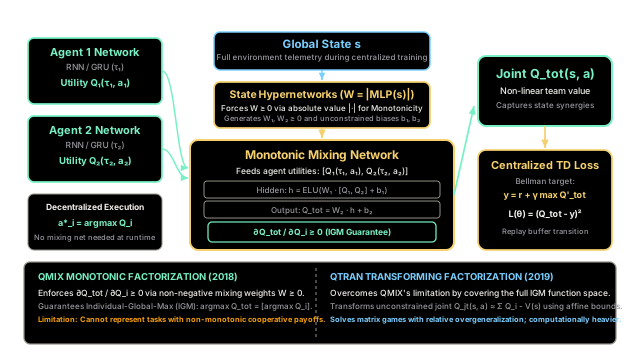
Why Does This Exist?
In cooperative multi-agent reinforcement learning (MARL), a team of agents must learn coordinated policies to maximize a single shared team reward .
The naive approach, Independent Q-Learning (IQL), has each agent train its own independent -network while ignoring the existence of other agents. As all agents update their policies simultaneously, the environment becomes severely non-stationary, causing coordinated behaviors to collapse.
At the other extreme, Centralized Q-Learning trains a single monolithic critic that takes all observations and outputs joint action-values . While stationary, the joint action space grows exponentially with team size (). For example, a team of 8 agents with 5 discrete actions each produces an intractable joint action space of actions, making finding the greedy action computationally impossible at inference time.
To bridge this gap, Sunehag et al. (2017) introduced Value-Decomposition Networks (VDN), assuming the joint value is simply the linear sum of individual utilities:
While linear addition enables decentralized execution, it is severely under-expressive. VDN cannot represent complex cooperative dynamics where an agent's marginal value depends non-linearly on the global state (e.g., in StarCraft II, a damaged unit's defensive maneuvers are far more critical than when it is at full health).
QMIX (Rashid et al., 2018) and QTRAN (Son et al., 2019) solved this expressiveness barrier. QMIX proved that joint action-values do not need to be linearly additive—they can be any non-linear function, provided the factorization satisfies a monotonicity constraint. By generating non-negative mixing weights via state-conditioned Hypernetworks, QMIX scales effectively to complex tasks while preserving decentralized execution.
Think of It Like This
The Corporate Revenue Dashboard
Imagine a global retail corporation with regional sales teams across several continents:
Under Linear Decomposition (VDN), total corporate profit is modeled as the plain arithmetic sum of each regional team's sales: . But this completely misses market synergies, state-dependent tax incentives, or shared logistic bottlenecks where one team's warehouse depends on another.
Under QMIX (Monotonic Mixing Panel), the company uses a dynamic software dashboard with non-linear dials controlled by executive macroeconomic conditions (the global state ). When market conditions shift, the dashboard dynamically rescales the impact of each team's efforts.
Crucially, every dial on the control panel is physically locked to have a positive or zero slope: Increasing any individual regional team's sales is mathematically guaranteed never to reduce overall corporate profit.
Because the system is strictly monotonic, each regional manager can sit in their local office, ignore global telemetry, and greedily maximize their own local sales target. They can be 100% confident that doing their personal best will automatically produce the optimal outcome for the entire corporation.
Where the analogy stops: In real business, a regional manager might make an aggressive move that creates negative externalities for another division. QMIX's mathematical monotonicity constraint forces the global mixing weights to be non-negative everywhere, meaning it cannot natively represent tasks where an individual action must sacrifice utility to unlock a non-monotonic team jackpot without specialized modifications (the relative overgeneralization limitation addressed by QTRAN).
How It Actually Works
The Individual-Global-Max (IGM) Condition
In cooperative MARL, agents observe local action-observation histories and select discrete actions . The global state is available during centralized training.
To allow decentralized deployment without real-time communication, the joint action-value function must satisfy the Individual-Global-Max (IGM) condition:
When IGM holds, finding the joint greedy action does not require evaluating all combinations. Each agent simply selects its local greedy action:
The decentralized choices are mathematically guaranteed to form the globally optimal joint action .
QMIX: Enforcing Monotonicity via Hypernetworks
QMIX satisfies IGM by enforcing a monotonicity constraint on the relationship between and each individual utility :
Agent Networks: Hypernetworks (conditioned on state s): τ₁ ──> [ Agent 1 ] ──> Q₁ s ──> [ |MLP₁(s)| ] ──> W₁ ≥ 0 τ₂ ──> [ Agent 2 ] ──> Q₂ s ──> [ |MLP₂(s)| ] ──> W₂ ≥ 0 │ │ │ │ ▼ ▼ ▼ ▼ ┌────────────────────────────────────────────────────────┐ │ Monotonic Mixing Network │ │ h = ELU(W₁ · [Q₁, Q₂] + b₁) │ │ Q_tot = W₂ · h + b₂ │ │ Guarantee: ∂Q_tot / ∂Q_i ≥ 0 │ └────────────────────────────────────────────────────────┘ │ ▼ Joint Value Q_tot(s, a)The Mixing Network Architecture
The mixing network is a feedforward neural network that takes the vector of individual utilities as input and produces scalar .
To make the factorization richly expressive and dependent on the environment context, the mixing network's weights are not fixed parameters. Instead, they are dynamically generated by Hypernetworks that take the global state as input:
- Layer 1 Weights (): A hypernetwork maps state to a matrix of size , where is the hidden dimension.
- Layer 2 Weights (): A hypernetwork maps state to a vector of size .
Guaranteeing Non-Negative Weights
To enforce monotonicity, all weights in the mixing network must be non-negative (). QMIX accomplishes this by passing the hypernetwork weight outputs through an absolute value activation function:
(Alternatively, a ReLU or exponential activation can be used). The biases and are generated by unconstrained MLPs of state , allowing the value baseline to shift freely.
By the chain rule, because , , and the hidden layer activation (e.g., ELU) is monotonically non-decreasing ():
Monotonicity is guaranteed for any state .
Centralized Training Objective
The entire architecture—agent RNNs, hypernetworks, and mixing network—is trained end-to-end to minimize the standard DQN temporal-difference loss:
where the Bellman target is computed using target network parameters :
QTRAN: Transforming Non-Monotonic Factorization
While QMIX is vastly more expressive than VDN, Son et al. (2019) demonstrated that monotonic functions form a strict subset of all IGM-satisfying games.
Consider a matrix game with a cooperative "jackpot" that requires both agents to choose action 1, but severely penalizes miscoordination. If one agent miscoordinates, the resulting payoff violates monotonicity. QMIX cannot represent such tasks, suffering from relative overgeneralization.
QTRAN solves this by formulating factorization through a linear transformation. It defines:
- An unconstrained joint action-value network .
- Individual agent utilities whose sum is regularized against using affine slack bounds:
where .
QTRAN proves that this transformation covers the entire theoretical class of IGM-factorizable games. However, in practice, the slack penalties introduce optimization challenges, making QMIX the prevailing practical standard for StarCraft II Multi-Agent Challenge (SMAC) benchmarks.
Worked numerical example
Let us trace a 2-agent QMIX forward mixing pass, verify monotonicity mathematically, and compute the centralized Bellman TD error.
Setup
- Global state:
- Agent utilities for chosen actions:
- Agent 1 utility:
- Agent 2 utility:
- Transition reward: , discount factor:
- Target network joint evaluation:
Step 1: Hypernetwork Output (Layer 1)
The state-conditioned hypernetwork outputs raw weights:
Applying the absolute value constraint:
The bias hypernetwork produces scalar bias:
Step 2: Layer 1 Mixing Activation
Compute the hidden layer activation :
(Assuming linear/active region of ELU: ).
Step 3: Hypernetwork Output (Layer 2) and Final Joint Value
The second hypernetwork generates final non-negative weight and bias:
Compute the centralized joint value :
Step 4: Verify Monotonicity Numerically
Suppose Agent 1 discovers a better local action, increasing its utility from to , while Agent 2 remains unchanged ():
Because , the team value strictly increases! Analytically, the partial derivative is:
Step 5: Compute Bellman Target and TD Error
Using target network evaluation :
The temporal difference error is:
The squared TD loss is:
Code
Below is a self-contained, type-hinted Python implementation of the complete QMIX forward mixing architecture, hypernetwork weight generation with absolute value constraints, monotonicity validation, and IGM condition verification:
from dataclasses import dataclassimport mathfrom typing import List, Tuple
@dataclassclass QMIXStepResult: """Stores intermediate activations and gradients from a QMIX forward pass."""
utilities: List[float] hidden_activation: float q_tot: float partial_derivative_q1: float td_error: float
class QMIXArchitecture: """Simulates QMIX's monotonic mixing network and state-conditioned hypernetworks."""
def __init__(self, gamma: float = 0.99) -> None: self.gamma = gamma
def hypernetwork_layer1( self, state: List[float] ) -> Tuple[List[float], float]: """Generates mixing weights W_1 >= 0 and bias b_1 from global state s.
Uses absolute value |W| to guarantee non-negative weights for monotonicity. """ raw_w11 = 1.5 raw_w12 = -0.8
# Enforce non-negativity constraint W_1 >= 0 w11 = abs(raw_w11) # 1.50 w12 = abs(raw_w12) # 0.80 b1 = 0.50 return [w11, w12], b1
def hypernetwork_layer2(self, state: List[float]) -> Tuple[float, float]: """Generates second layer mixing weight W_2 >= 0 and scalar bias b_2.""" raw_w2 = 2.0 w2 = abs(raw_w2) # 2.00 b2 = 1.00 return w2, b2
def forward_mixing( self, state: List[float], utilities: List[float] ) -> Tuple[float, float, float]: """Computes Q_tot = Mixing(Q_1, ..., Q_N; s).
Returns: (Q_tot, hidden_activation, analytical_dQ_tot_dQ1). """ w1, b1 = self.hypernetwork_layer1(state) w2, b2 = self.hypernetwork_layer2(state)
# Layer 1: h = W_1 * [Q_1, Q_2] + b_1 h = w1[0] * utilities[0] + w1[1] * utilities[1] + b1
# Layer 2: Q_tot = W_2 * h + b_2 q_tot = w2 * h + b2
# Analytical partial derivative dQ_tot / dQ_1 = W_2 * W_1[0] partial_derivative_q1 = w2 * w1[0]
return q_tot, h, partial_derivative_q1
def compute_td_error( self, q_tot: float, reward: float, target_next_q_tot: float ) -> float: """Computes Bellman TD error: delta = r + gamma * max Q'_tot - Q_tot.""" target_y = reward + self.gamma * target_next_q_tot return target_y - q_tot
def verify_igm_condition( self, state: List[float], agent1_action_utilities: List[float], agent2_action_utilities: List[float], ) -> bool: """Verifies Individual-Global-Max (IGM):
argmax_a Q_tot(s, a) == (argmax_a1 Q_1, argmax_a2 Q_2). """ best_a1 = max( range(len(agent1_action_utilities)), key=lambda i: agent1_action_utilities[i], ) best_a2 = max( range(len(agent2_action_utilities)), key=lambda i: agent2_action_utilities[i], )
joint_q_values = [] for i, u1 in enumerate(agent1_action_utilities): for j, u2 in enumerate(agent2_action_utilities): q_tot, _, _ = self.forward_mixing(state, [u1, u2]) joint_q_values.append(((i, j), q_tot))
best_joint = max(joint_q_values, key=lambda item: item[1])[0] return best_joint == (best_a1, best_a2)
if __name__ == "__main__": qmix = QMIXArchitecture(gamma=0.99) state = [1.0, 0.5] utilities = [3.0, 2.0]
# 1. Forward Mixing Pass (Worked Numerical Example) q_tot, h, dQ_dQ1 = qmix.forward_mixing(state, utilities)
# 2. Bellman Target and TD Error reward = 2.0 target_q_next = 15.0 td_error = qmix.compute_td_error( q_tot=q_tot, reward=reward, target_next_q_tot=target_q_next )
print("=== QMIX Forward Mixing Pass ===") print(f"Global State: {state}") print(f"Agent Utilities [Q_1, Q_2]: {utilities}") print(f"Hidden Activation h: {h:.2f}") print(f"Joint Value Q_tot: {q_tot:.2f}") print(f"Derivative dQ_tot / dQ_1: {dQ_dQ1:.2f} (strictly >= 0)") print(f"Centralized TD Error delta: {td_error:.4f}")
assert math.isclose(h, 6.60) assert math.isclose(q_tot, 14.20) assert math.isclose(dQ_dQ1, 3.00) assert math.isclose(td_error, 2.65)
# 3. Monotonicity Test: Increase Q_1 from 3.0 to 4.0 utilities_increased = [4.0, 2.0] q_tot_inc, h_inc, _ = qmix.forward_mixing(state, utilities_increased) print("\n=== Monotonicity Verification ===") print(f"Updated Utilities: {utilities_increased}") print(f"Updated Hidden h: {h_inc:.2f}") print(f"Updated Q_tot: {q_tot_inc:.2f}") assert q_tot_inc > q_tot print("Monotonicity confirmed: Increasing local Q_1 strictly increased joint Q_tot!")
# 4. Individual-Global-Max (IGM) Decentralized Execution Test # Discrete actions for agent 1: [1.0, 3.0, 2.0] -> argmax = index 1 # Discrete actions for agent 2: [0.5, 2.0, 1.2] -> argmax = index 1 igm_holds = qmix.verify_igm_condition( state, agent1_action_utilities=[1.0, 3.0, 2.0], agent2_action_utilities=[0.5, 2.0, 1.2], ) print("\n=== IGM Condition Check ===") print(f"Individual-Global-Max Holds: {igm_holds}") assert igm_holds
print("\nAll QMIX numerical assertions verified successfully!")Expected output:
=== QMIX Forward Mixing Pass ===Global State: [1.0, 0.5]Agent Utilities [Q_1, Q_2]: [3.0, 2.0]Hidden Activation h: 6.60Joint Value Q_tot: 14.20Derivative dQ_tot / dQ_1: 3.00 (strictly >= 0)Centralized TD Error delta: 2.6500
=== Monotonicity Verification ===Updated Utilities: [4.0, 2.0]Updated Hidden h: 8.10Updated Q_tot: 17.20Monotonicity confirmed: Increasing local Q_1 strictly increased joint Q_tot!
=== IGM Condition Check ===Individual-Global-Max Holds: True
All QMIX numerical assertions verified successfully!Watch Out For
The Relative Overgeneralization Failure Mode
The Trap: While monotonicity guarantees that , it severely restricts the class of payoff matrices QMIX can represent. In matrix games with "penalty traps" (relative overgeneralization), a high-reward collaborative action yields if both agents coordinate, but if either miscoordinates, while a sub-optimal safe action yields unconditionally. Because QMIX must enforce a monotonic ranking across all joint actions, individual utility gradients average across peer missteps during exploration. The local utilities for the optimal collaborative action fall below the safe action, permanently locking the team into the suboptimal equilibrium.
The Symptom: On matrix games or coordination puzzles requiring precise joint sacrifice, QMIX's evaluation curves plateau at suboptimal safe policies, failing to ever discover the global optimum despite million-step training.
The Fix:
- Weighted QMIX (WQMIX): Introduce an asymmetric weighting scheme that assigns higher weight to transitions where the centralized projection underestimates values (), allowing the network to escape relative overgeneralization traps.
- QTRAN Transformation: Use QTRAN to factorize the value function via unconstrained joint -networks regularized by state-value baselines , covering the full non-monotonic IGM function space.
- Exploration Temperature Schedules: Implement optimistic exploration techniques (such as Maven or episodic curiosity) that encourage deep joint exploration before monotonic factorization hardens.
The Quick Version
- Non-Linear Value Factorization: QMIX overcomes the restrictive additive assumption of VDN (), factorizing joint team values through a state-conditioned, non-linear mixing network.
- Monotonicity Guarantees IGM: Enforcing guarantees the Individual-Global-Max (IGM) condition, ensuring that decentralized local greedy actions align with the global team optimum.
- State Hypernetworks: Mixing network weights are dynamically generated from global state via Hypernetworks and constrained to be strictly non-negative () via absolute value activations.
- Decentralized Runtime Autonomy: At execution time, the mixing network and global state are completely discarded; each agent executes independently with zero communication overhead.