S4 Brings Structured States to Vision
S4 parameterizes state matrices for long memory with fast kernels, giving vision a linear long-range option before selection.
Why Does This Exist?
RNNs vanish on K pixel strings. Attention handles them but costs M pairs.
S4 structures memory. It precedes vision mamba selection, grounds state spaces, and informs convolutional layers long-range debates.
Think of It Like This
Tuned echo chambers instead of plain rooms
Plain rooms echo muddy. Shaped chambers hold tones for seconds with clear decay.
HiPPO init shapes chambers, discretization tunes decay. Where it stops: fixed shapes suit all inputs alike, just as S4 lacks per-input selection.
How It Actually Works
Discretize with step to . HiPPO sets to memorize history optimally in dims. Run as recurrence or long conv kernel .
Worked example
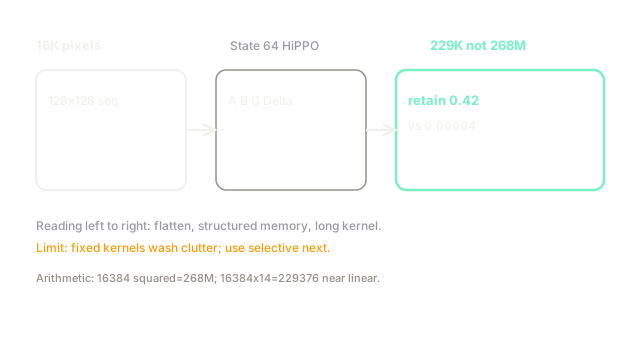
pixels. Attention M pairs. S4 kernel length with state runs near K steps. Decay versus HiPPO retention shows long memory kept.
Watch Out For
Using S4 where selection matters most
Fixed kernels average clutter with targets. Symptom: fine detail washes on busy scenes. Fix: move to selective Mamba variants for cluttered dense tasks.
The Quick Version
- S4 structures dim states with HiPPO for long memory.
- Runs as recurrence or K long conv kernels.
- Fixture K steps replace M pairs.
- Fixed after training, unlike selective scans.
- Use selective successors for cluttered scenes.