Source-Free Domain Adaptation
Adapt a trained model to a new domain using only unlabeled target images, because policy or size keeps the source data out of reach.
Why Does This Exist?
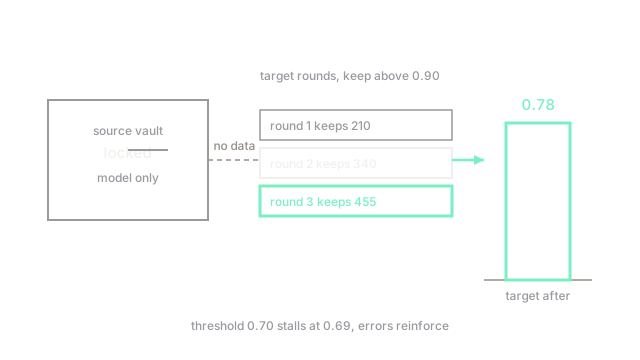
Unsupervised adaptation needs source and target images together, but vendors ship models without their training data, hospitals cannot export scans, and datasets age out of licenses. The model arrives; its source data does not. Source-free adaptation takes the trained source model plus unlabeled target images and nothing else.
It trades recovery for access: less signal than joint training, usable in far more deployments. The blind preparation alternative is domain generalization.
Think of It Like This
A chef adapting a recipe in a new kitchen
A chef memorized a recipe but left the cookbook behind, and the new kitchen stocks unfamiliar brands. She cooks from memory, tastes each attempt, and keeps the versions that taste right, converging without ever reopening the book. The trained weights are the memorized recipe, target images are the tastings, confident pseudo-labels are the kept versions. The analogy stops at verification: taste is ground truth for food, while pseudo-labels can be confidently wrong.
How It Actually Works
Freeze the source classifier head and adapt the feature extractor so target features cluster tightly and sit confidently inside source decision regions. The usual loop generates pseudo-labels from confident predictions, retrains features on them, and repeats, sometimes with an information-maximization term that keeps predictions sharp per image yet diverse across the batch. No source image is ever reloaded.
Worked example with recomputed numbers
Night-rain target starts at 0.63 with the shipped daylight model. Three pseudo-label rounds keeping predictions above 0.90 confidence lift target accuracy to 0.78, a gain of 0.15 against 0.19 for joint unsupervised training on the same data. Lower the keep threshold to 0.70 and accuracy stalls at 0.69 because wrong labels enter the loop and reinforce themselves. The threshold is the visible dial between signal and self-deception.
The contract and limit
Assumes the source model is decent on the target already, here 0.63, so confident predictions are mostly right. Below about 0.50 initial accuracy the loop amplifies errors faster than it corrects them. Pair with test-time adaptation when even target training access is limited to inference batches.
Watch Out For
Confident pseudo-labels that confirm errors
Early mistakes above threshold become training data, and accuracy climbs on the confident subset while true accuracy falls. The symptom is rising pseudo-label agreement with flat or falling held-out accuracy. Fix it with neighborhood consistency checks and a second-seed agreement gate before promoting labels.
The Quick Version
- Adapts with the source model plus unlabeled target images, never source data.
- The worked target moves 0.63 to 0.78 across three confident rounds.
- Keep thresholds high: 0.90 succeeds where 0.70 stalls at 0.69.
- Needs a usable starting model, or the loop amplifies its own errors.
- Choose it when policy or logistics lock the source away.