Information Theory
Information theory prices uncertainty in bits. This hub links the entropy, coding, and tradeoff pages without re-teaching them.
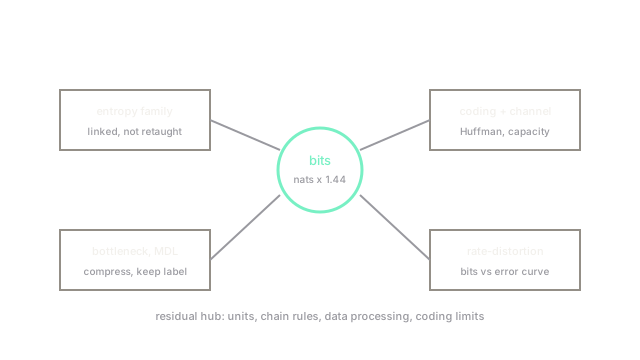
Why Does This Exist?
Entropy, cross-entropy, KL, and mutual information already teach their own mechanisms elsewhere on this site. A residual hub is still needed for what none of them owns: shared units, chain rules across variables, the data-processing limit, and how coding, bottleneck, MDL, and rate-distortion divide the territory. Without it readers re-derive units per page and miss the shared ceiling.
This page is that hub by contract: it links components, never re-teaches them. Component owners: entropy for surprise averaging, cross-entropy for coding with the wrong model, KL divergence for the extra-bit price, mutual information for shared bits. Residual pages below are the only new mechanisms here.
The one idea you need first
One bit halves uncertainty: a fair coin carries 1 bit, four equiprobable symbols carry 2. Nats use instead of (1 nat bits). Every formula here is a bit price; unit mistakes scale every number.
Think of It Like This
A currency board, not a mint
This hub is a currency board: it fixes the exchange (bits versus nats), posts member banks' rates (entropy, KL, MI pages), and charters only the shared roads (chain rules, processing limits, coding theorems).
Minting new coins here would duplicate the members. Where it stops: exchange boards do not lend. Quantitative claims live on member pages; this page routes.
How It Actually Works
Residual mechanisms owned here, each on its own page:
- Joint and conditional entropy: chains staged prediction; see joint and conditional entropy.
- Jensen-Shannon: symmetric capped midpoint of KLs for comparing distributions; see Jensen-Shannon divergence.
- Data processing: on chains ; post-processing cannot invent bits, see data processing inequality.
- Bottleneck: minimize to compress while keeping label bits; see information bottleneck.
- Source and channel coding: entropy floors compression, capacity ceilings transmission; see source and channel coding.
- MDL and rate-distortion: model bits plus data bits pick models; bitrate-error curves price lossy compression, see minimum description length and rate-distortion theory.
Worked example
Two independent fair coins: each carries bit, joint bits, conditional bit, chain checks. Correlate them so always: joint drops to 1 bit, , MI . Same margins, dependence decides the totals. The arithmetic belongs to the joint page; the routing belongs here.
Watch Out For
Re-deriving units per page
Mixing bits and nats across entropy, KL, and bottleneck pages scales answers 1.44x silently. A "0.69 threshold" in nats is "1.0" in bits; comparing them raw misfires every gate.
Fix units at the hub: state bits or nats per formula, convert explicitly. If a number looks off, it is units.
Expecting post-processing to add information
No classifier, embedding, or prompt trick beats the data-processing ceiling: never exceeds the upstream . Teams stack heads hoping signal appears; the hub says buy better instead.
Audit upstream information before downstream architecture. If is capped, collect features, not layers.
The Quick Version
- This hub routes; entropy, cross-entropy, KL, and MI pages teach their mechanisms.
- Bits halve uncertainty; nats differ by , about 1.44x.
- Two fair coins total 2 bits; perfect correlation drops the joint to 1.
- Chain, processing, bottleneck, coding, MDL, and rate-distortion live on residual pages.
- State units per formula and convert explicitly.
- Post-processing never beats its upstream information.